


Are you looking for the best abdominal belts for men in 2026, but every online ranking seems to be selling a different product? This guide takes a different approach. Rather than rating brands, we compare the five major types of belts that actually exist: classic EMS, EMS with arm straps, EMS patch, neoprene sweat belt, and lumbar support belt. For each: principle, scientific evidence, target profile, price, and limitations.
This comparison is based on published trials, not on in-house tests or user ratings. You will then find purchasing criteria, an 8-week protocol designed for men, classic mistakes, and a recommendation by objective. For a detailed explanation of how it works, our complete guide to electrostimulation abdominal belts remains the benchmark.
Why compare by type rather than by brand?
Most "top 5s" compile product sheets and assign stars without ever plugging in a device. Brands change their references every season, while the technology remains stable: a belt contracts the muscle via electrical impulse, increases local heat, or supports the core. Understanding these three mechanisms allows you to choose without relying on a ranking.
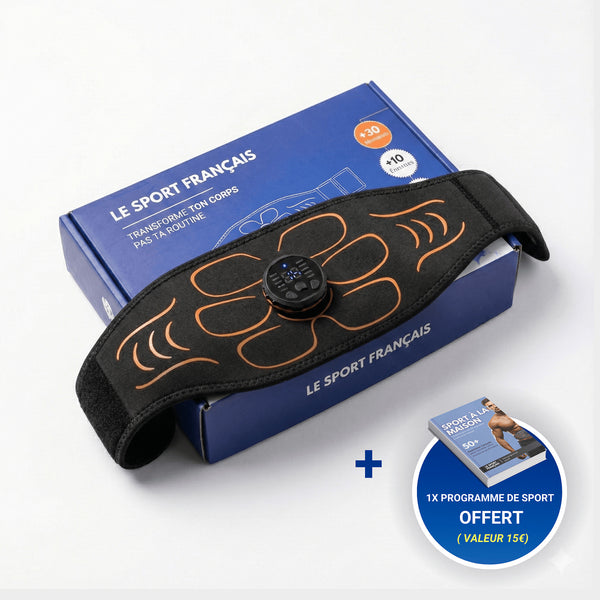
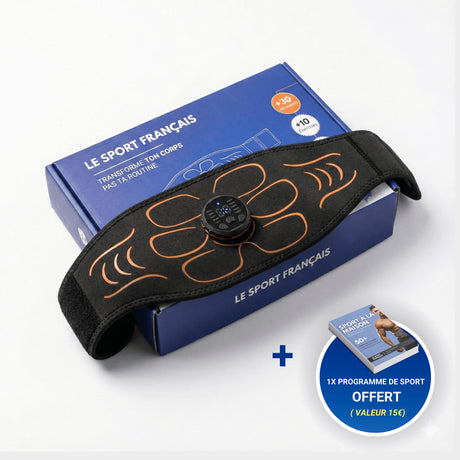
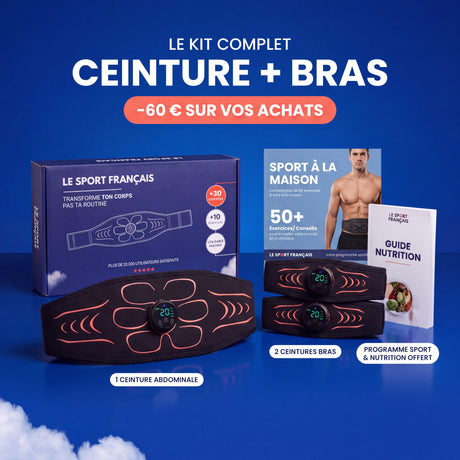
At Le Sport Français, our reference for electrostimulation is the EMS muscle abdominal belt. We will use it as a concrete example of the "classic EMS" category, without presenting it as a miracle solution.
What does science say about abdominal belts?
The most cited study is that of Porcari et al. (2005, Journal of Sports Science and Medicine). For 8 weeks, adults used an EMS abdominal belt 5 times a week, 20 to 40 minutes per session. Result: abdominal strength +58%, endurance +100%, waistline reduced by an average of 3.6 cm. However, no loss of fat mass was measured. The belt tones; it does not make you lose weight.
Hwang and Kwon (2023, Journal of Back and Musculoskeletal Rehabilitation) measured 8 weeks of abdominal electrostimulation followed by 4 weeks of cessation. The thickness of the rectus abdominis and obliques increased, as did strength, endurance, and lombo-pelvic control. After stopping, muscle volume remained higher than at the start, but strength and endurance returned to their initial levels. Consistency is therefore key.
Maffiuletti (2010, European Journal of Applied Physiology) points out that the effectiveness of electrostimulation depends on the tolerated intensity: the higher the current, the stronger the contraction. This is a useful piece of information for men, whose current tolerance is often higher.
For sweating, Haney et al. (2017, International Journal of Research in Exercise Physiology) compared 8 weeks of training with and without sweat gear. The equipped group lost more fat mass (-13.8% versus -8.3%), but because they were training: neoprene alone does not produce anything measurable. To go further, read do abdominal belts really work.
The 5 types of men's abdominal belts compared
Type 1: the classic EMS belt
Principle: a flexible band with 4 to 6 electrodes that send low-frequency impulses. The muscle contracts involuntarily, just like during a plank. Evidence: the only type of belt to have demonstrated a gain in abdominal strength and endurance in a controlled trial (Porcari et al., 2005). For whom: the sedentary man getting back into shape, the athlete supplementing their ab workouts, or the one who cannot do crunches due to back issues.
Price: €40 to €150 depending on the range; our model is €59.99. Limitations: no fat loss, results visible only if your fat mass is moderate, rapid de-training in case of cessation (Hwang and Kwon, 2023).
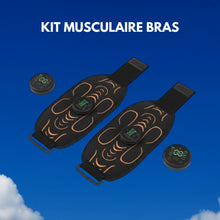
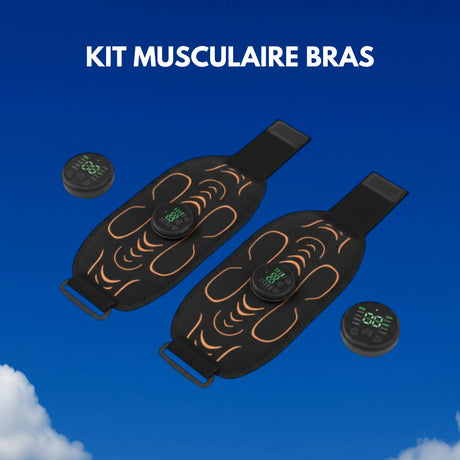
Type 2: the EMS belt with arm straps
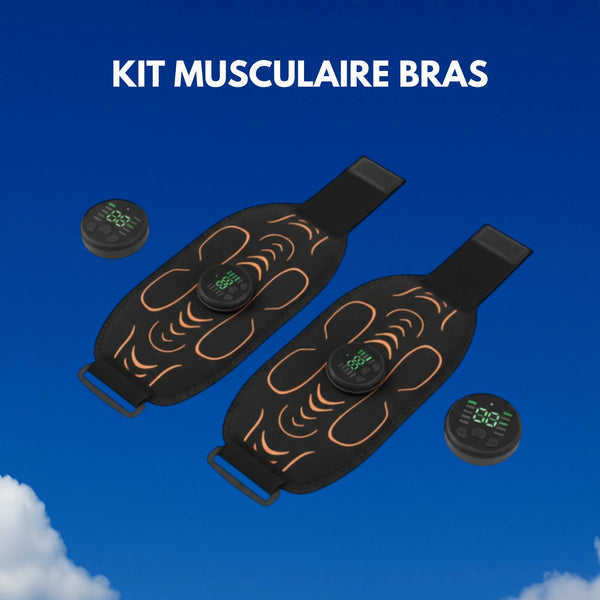
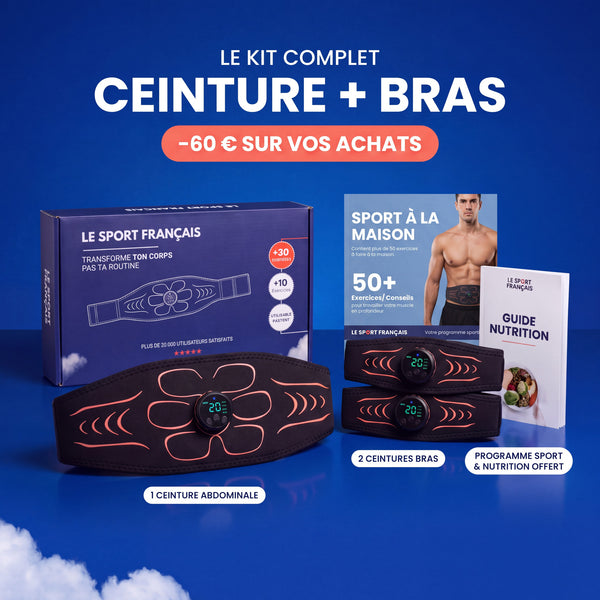
Principle: the same central unit controls an abdominal belt and two bicep/tricep straps; you alternate areas from one session to the next. Evidence: mechanisms identical to abdominal EMS, in addition to voluntary training (Maffiuletti, 2010). For whom: the man who wants to work his stomach and arms without having to juggle multiple devices.
Price: €70 to €120. The sports belt + straps kit is €89.99. Limitations: session time doubles if you stimulate everything on the same day; straps do not replace pull-ups and push-ups.
Type 3: the abdominal EMS patch
Principle: a thin, "six-pack" shaped adhesive pad, without straps, with a small box clipped onto it, stuck directly to the skin. Evidence: same technology as the belt, but reduced electrode surface area, so contraction is generally less deep. For whom: the man who is already slim and looking for finishing work or a discreet device.
Price: €30 to €60. The abdominal EMS patch is sold for €40.99. Limitations: adhesive gel needs replacing after a few dozen uses, lower perceived power, poor adhesion on hairy or sweaty skin.
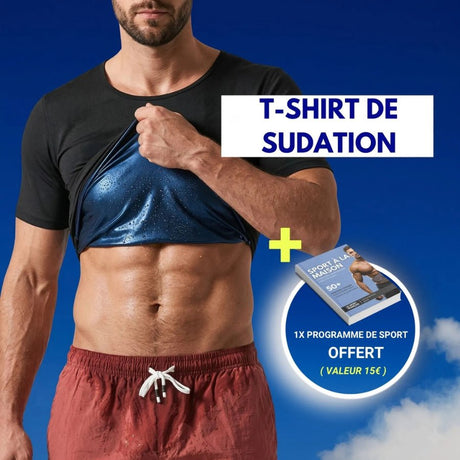
Type 4: the neoprene sweat belt
Principle: no electricity. Neoprene insulates the abdominal area and increases local temperature during exertion. Evidence: Haney et al. (2017) show a benefit for fat mass only when associated with an exercise program. At rest, the belt only causes water loss. For whom: the man who already does cardio or bodybuilding and wants more heat and support during the session.
Price: €30 to €70. The men's sweat belt (sizes S to XXL, adjustable straps) costs €64. Limitations: risk of dehydration, discomfort in high heat, no effect on muscle. To address the real cause, read our article on abdominal fat in men.
Type 5: the lumbar support belt
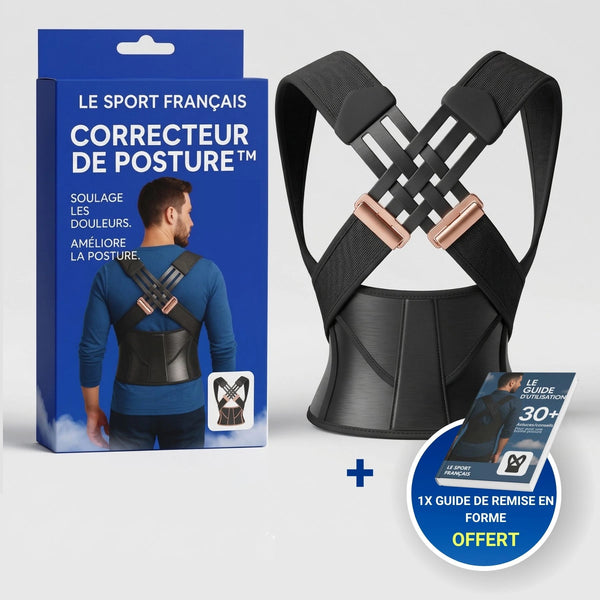
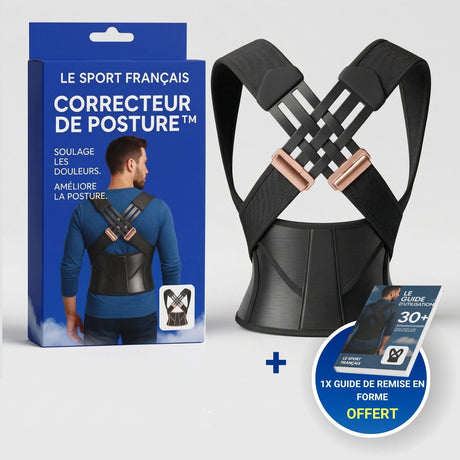
Principle: a wide, rigid belt that limits lower back movement and reminds you of good posture. Evidence: occasional use when lifting loads is documented in ergonomics, but prolonged wear is not recommended because the stabilizers stop working. For whom: the man who has back pain after a day on his feet or who lifts loads, in addition to core strengthening.
Price: €25 to €80. The neoprene sculpting fitness belt at €47 plays this support role during the session. Limitations: does not build muscle, does not make you lose weight, and never replaces a medical consultation in case of persistent pain.
What criteria should you use to choose an abdominal belt?
Intensity levels and programs
A trained man quickly hits the ceiling of a 5-level belt. Aim for at least 15 intensity levels and several programs (warm-up, toning, endurance, massage). Progressiveness matters as much as maximum power.
Electrodes and contact surface
The larger the electrode surface, the deeper and more comfortable the contraction. Check the availability of replacement conductive gels: without them, the belt becomes unusable within a few months.
Battery life and recharging
Prefer a unit rechargeable via USB rather than button batteries. Count on at least five 20-minute sessions per charge. The USB rechargeable EMS central unit at €15 allows you to replace the box without buying a new belt.
Size and fit
A belt that is too short will not close on a waistline larger than 100 cm; if it is too long, it leaves the electrodes loose. Measure your waistline at the navel and check the stated range.
CE standards and safety
An electrostimulator sold in Europe must bear the CE mark. Neuromuscular stimulators also fall under the IEC 60601-2-10 electrical safety standard, which governs the currents delivered. Beware of devices without manuals in your language or an identified manufacturer.
Warranty and spare parts
The two-year legal warranty of conformity applies in France. Beyond that, check the availability of consumables: gels, control unit, arm straps. A manufacturer that sells them separately saves you money in the long run.
Which abdominal belt according to your goal?
Goal: Toning the abdominal wall
Choose a classic EMS belt or one with arm straps, the only category with measured gains in strength and endurance. Combine it with two plank sessions per week.
Goal: Cutting and losing belly fat
No belt melts fat. The main lever remains a moderate caloric deficit and 150 minutes of activity per week. The sweat belt can accompany your cardio sessions, and EMS maintains muscle during a cut.
Goal: Relieving and protecting the back
A lumbar support belt provides occasional help during exertion. In the long term, it is the strengthening of the transversus and obliques that protects the back, and abdominal EMS has shown improvement in lombo-pelvic control (Hwang and Kwon, 2023).
How to use an abdominal belt as a man?
This protocol follows the structure of clinical trials (8 weeks, 5 weekly sessions). Trim hair at the electrode level to improve contact. Lightly moisten the skin, center the belt over the navel, and tighten without compressing.
Weeks 1 to 2: adaptation
5 sessions of 20 minutes, toning program, low to moderate intensity (clear but comfortable contraction). Increase by one level per session. Add 3 sets of 30-second planks twice a week.
Weeks 3 to 5: progression
5 sessions of 25 to 30 minutes, moderate to high intensity. Alternate between a toning day and an endurance day. Increase the plank to 3 sets of 45 seconds and add 3 sets of 15 leg raises. With arm straps, stimulate arms during two of the five sessions.
Weeks 6 to 8: intensification
5 sessions of 30 to 40 minutes at the highest intensity tolerated without pain. Finish with a 5-minute massage program for recovery.
After 8 weeks: maintenance
Reduce to 3 sessions of 20 to 30 minutes per week. Strength returns to the initial level after 4 weeks without stimulation: maintenance is not optional. Find other protocols by profile in our complete guide to men's and women's ab belts.
Limitations, mistakes to avoid, and contraindications
First limitation, physiological: an EMS belt does not burn fat and will not make defined abs appear if your fat mass exceeds 15 to 18%. Second limitation, the sensation: the tingling is annoying at first, and some quit before the third week, just when the adaptations begin.
- Increasing intensity too quickly: severe muscle soreness and quitting. One notch per session is enough.
- Wearing the belt over clothing: the fabric blocks the current. Bare skin or a very thin t-shirt only.
- Using dry or worn-out electrodes: the current concentrates and stings. Replace the gels.
- Believing that sweating is enough: the lost water returns within a few hours. Only the combination with exercise has shown an effect.
- Wearing a lumbar belt all day: the stabilizers relax. Reserve it for exertion.
- Stopping as soon as results appear: strength disappears in a month without maintenance.
Contraindications to electrostimulation: pacemaker or electronic implant, rhythm disorders, epilepsy, abdominal or inguinal hernia, skin lesions on the area, cancer currently being treated, pregnancy. In case of recent abdominal surgery or doubt, ask your doctor for advice. The sweat belt is not recommended in case of cardiovascular problems.
Which men's abdominal belt to choose? Our solution
For the majority of men, classic EMS is the best starting point. The Le Sport Français EMS muscle abdominal belt, at €59.99, brings together the useful features: adjustable flexible band, several programs (activation, toning, endurance, massage), progressive intensity, and a USB rechargeable central unit. It is worn directly on the skin.
If you also wish to work your arms, the sports kit at €89.99 adds two bicep/tricep straps controlled by the same box. If you prefer a discreet device, the abdominal patch at €40.99 is the lightest option. To accompany your cardio sessions, the men's sweat belt at €64 adjusts from S to XXL. And if your box weakens, the central unit can be replaced alone for €15.
What these products do: contract your abs, increase heat, or support your core. What they do not do: lose weight for you. For more technical details, our article on the electrostimulation ab belt compares models in depth.
Frequently asked questions
What is the best abdominal belt for a man?
The one that corresponds to your goal. To tone, an EMS belt with at least 15 intensity levels, large electrodes, and USB charging. To accompany a cut, a sweat belt worn during exercise. For the back, occasional lumbar support. No single belt is the best at everything.
Does an abdominal belt help you lose belly fat?
No, not directly. Porcari et al. (2005) measured a waistline reduction of 3.6 cm thanks to toning, but no loss of fat mass. To lose belly fat, you need a caloric deficit and physical activity. The belt makes the muscle firmer, which improves appearance once fat is reduced.
How long before seeing results?
Studies use protocols of 8 weeks with 5 weekly sessions. The first sensations of firmness generally appear after 2 to 3 weeks; strength gains are measurable at 8 weeks. Visual results depend primarily on your body fat and diet.
Can you use an EMS belt every day?
Five sessions per week is the frequency used in clinical trials and is suitable for most men. Daily use is possible at moderate intensity, alternating areas if you have arm straps. Keep one to two days of rest per week, as with any training.
Is the sweat belt dangerous?
Not if you use it with common sense: only during exercise, never for more than an hour, while drinking regularly, and never in extreme heat. It is not recommended for people with cardiovascular problems. Remove it in case of dizziness, nausea, or headaches, which are signs of dehydration.
What you need to remember
- Five types of abdominal belts: classic EMS, EMS + straps, EMS patch, neoprene sweat belt, and lumbar support. Each serves a different goal.
- Only EMS has demonstrated a gain in strength (+58%) and endurance (+100%) in 8 weeks, with no fat loss (Porcari et al., 2005).
- Strength gains disappear in 4 weeks without stimulation: maintenance at 3 sessions per week is essential (Hwang and Kwon, 2023).
- The sweat belt is only of interest when combined with exercise; at rest, it only causes water loss.
- Purchasing criteria: at least 15 intensity levels, large electrodes, USB recharge, appropriate size, CE marking, available consumables.
- Men's protocol: 8 weeks, 5 sessions of 20 to 40 minutes, increasing the level by one each session, with core strengthening as a supplement.
Conclusion
The best abdominal belts for men are not ranked by stars but by usage. To strengthen the abdominal wall, electrical stimulation is the only type of belt supported by published trials, provided you are consistent and add core exercises. To lose belly fat, the belt provides support, but diet and physical activity are the deciding factors.
If you want to start with a device designed for regular home use, the EMS muscle abdominal belt at €59.99 is our recommended starting point. Follow the 8-week protocol, then move on to maintenance: it is the only strategy that yields lasting results.
Sources
- Porcari J.P., Miller J., Cornwell K., Foster C., Gibson M., McLean K., Kernozek T. (2005). The effects of neuromuscular electrical stimulation training on abdominal strength, endurance, and selected anthropometric measures. Journal of Sports Science and Medicine, 4(1), 66-75. pubmed.ncbi.nlm.nih.gov
- Hwang U.J., Kwon O.Y. (2023). Effect of electrical stimulation training and detraining on abdominal muscle function. Journal of Back and Musculoskeletal Rehabilitation, 36(4), 831-843. journals.sagepub.com
- Maffiuletti N.A. (2010). Physiological and methodological considerations for the use of neuromuscular electrical stimulation. European Journal of Applied Physiology, 110(2), 223-234. pubmed.ncbi.nlm.nih.gov
- Haney N., Dalleck L.C., et al. (2017). Health-related benefits of exercise training with a sauna suit: a randomized controlled trial. International Journal of Research in Exercise Physiology, 13(1). ijrep.org