









Shoulders rolling forward, head leaning toward the screen, back rounding as the day goes on: if you recognize yourself, you have probably already heard of a posture corrector.
This master guide explains what a posture corrector really is, how it works, who it is for, how to wear it week after week, which exercises to pair it with, and what its limitations are, along with the criteria for choosing a model like our back and shoulder posture corrector.
What is a posture corrector?
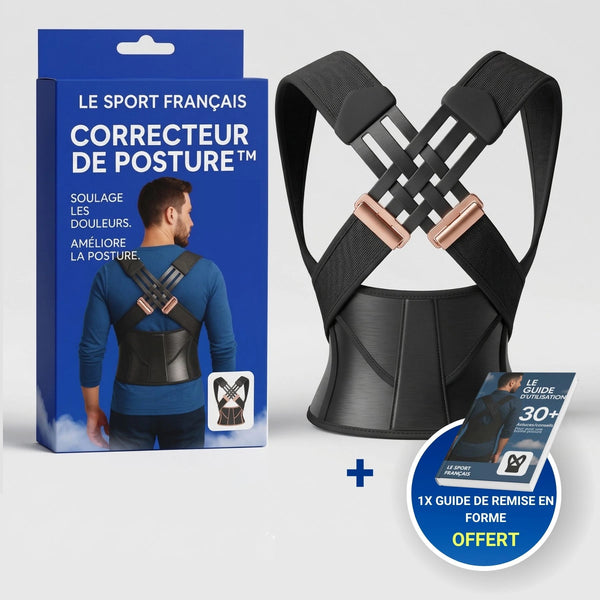
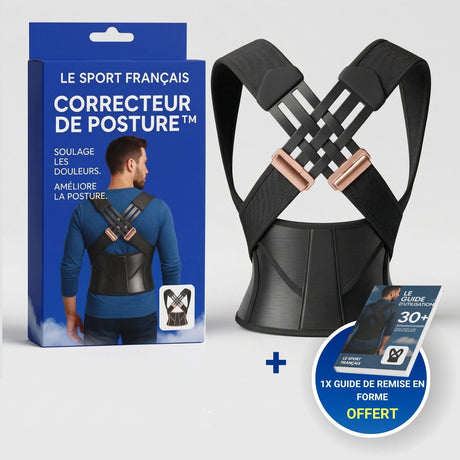
A posture corrector is a textile device worn on the upper body. It generally consists of two elastic straps that go under the armpits and cross over the back, connected to an adjustable back band. When the shoulders roll forward, the straps tighten and exert a gentle backward pull.
There are several families of products sold under this name: back braces (the most common format), "posture" vests and t-shirts with integrated elastic bands, lumbar belts with reinforcements, and small electronic sensors that vibrate when you slouch. In this article, we mainly discuss back braces, which target rounded shoulders and a rounded upper back. For a detailed comparison of formats, see our physiotherapist's review and our 5 criteria for choosing a posture corrector.
How does a posture corrector work?
The most important point to understand: a posture corrector is not a corset. It does not "hold" your spine in place and should not be rigid enough to do so. Its action relies on three complementary mechanisms.
Proprioceptive feedback
Proprioception is your nervous system's ability to perceive your body's position without looking at it. When you slump, the straps tighten and create a distinct sensation on the shoulders. Repeated dozens of times a day, this feedback helps build a new postural habit.
Light mechanical traction
The corrector pulls the shoulders back and slightly opens the rib cage. This traction remains moderate: it guides rather than forces.
Awareness
Many users discover while wearing the device just how much they slouch at the office, in the car, or on the sofa. This awareness is perhaps the most lasting effect: it persists after removing the corrector, provided it is supported by exercises.
What does science say about posture correctors?
Scientific data invite caution and honesty. A systematic review of ten studies and 450 patients concludes that orthotic devices can improve postural parameters and reduce forward head projection, while highlighting the lack of long-term follow-up and the need to improve device comfort (Hamzelouie et al., 2025, Journal of Rehabilitation and Assistive Technologies Engineering). The same review reports that a postural correction garment tested on students did not significantly change head or shoulder position in the short term (Manor et al., 2016, Journal of Sport Rehabilitation).
A randomized cross-over trial conducted on 30 healthy men points in the same direction: a posture-cueing t-shirt did not change head and shoulder angles during a computer task, with a reduction in discomfort deemed negligible (Christensen et al., 2022, Journal of Manipulative and Physiological Therapeutics). In other words, wearing a garment does not mechanically correct posture in a person who does nothing else.
Conversely, exercises have a well-documented effect. A meta-analysis of 22 studies and 903 participants shows that strengthening, stretching, and targeted shoulder exercises significantly improve head posture, rounded shoulders, and thoracic kyphosis in people with "upper crossed syndrome" (Sepehri et al., 2024, BMC Musculoskeletal Disorders). For the lower back, a Cochrane review of 249 trials and over 24,000 patients concludes that exercise reduces pain and improves function in cases of chronic low back pain, with a low to moderate level of evidence and a clearer effect in the short term (Hayden et al., 2021, Cochrane Database of Systematic Reviews). Prolonged rest, however, is not a solution. The corrector is therefore a learning tool, not a treatment.
Who is the posture corrector for?
The corrector is primarily suitable for people who adopt a slumped posture out of habit, without an underlying pathology. The most relevant profiles:
- People who work several hours a day in front of a screen or teleworking at a poorly adjusted workstation.
- Heavy smartphone users, with heads often tilted forward.
- Athletes whose pectorals dominate their upper back ("push" oriented bodybuilding, swimming).
It in no way replaces medical advice in case of persistent pain, scoliosis, or spinal pathology. In these situations, a physiotherapist remains the primary point of contact.
How to wear a posture corrector?
The golden rule: gradually, never all day long. Continuous wear removes the work of postural muscles, exactly the opposite of the goal. Here are the practical basics.
Proper adjustment
Put the corrector on like a backpack, over a thin t-shirt to avoid friction. Tighten the straps until you feel a distinct reminder when you slouch, but without hindering breathing or compressing the armpits. If red marks appear after 30 minutes, loosen them.
When to wear it
Wear it during static periods: seated work, reading, car or train commutes. Avoid wearing it during exercise (it hinders shoulder blade movement), during sleep, and during household chores that require a full range of motion for the shoulders.
4-week wearing schedule
- Week 1: 20 to 30 minutes per day, in one session, to get used to it.
- Week 2: Two 30-minute sessions per day, during your most "slouched" moments (early afternoon at the office, for example).
- Week 3: 1 hour to 1.5 hours per day, split into 2 or 3 sessions.
- Week 4: 1.5 to 2 hours per day maximum, always split. Start voluntarily removing the corrector 10 minutes before the end of a session and try to maintain the position on your own.
Beyond the fourth week, gradually reduce wearing time and keep the corrector as an occasional "reminder." The true goal is to be able to do without it. You will find the expected benefits detailed in our article on the benefits of a back posture corrector.
Which exercises to pair with a posture corrector?
Without exercises, the corrector's effect disappears as soon as you take it off. Here is a basic 15-minute program, 3 times a week, to follow for 8 weeks.
Upper back strengthening
- Scapular retraction: standing or sitting, squeeze your shoulder blades toward each other for 3 seconds then release. 3 sets of 12 repetitions.
- Y-T-W on the floor: lying on your stomach, arms in Y, then T, then W, lift your arms slightly. 2 sets of 8 repetitions per position.
- Horizontal pull with resistance band or towel: elbows along the body, pull toward you while squeezing the shoulder blades. 3 sets of 12 repetitions.
Pectoral and neck stretches
- Doorway pectoral stretch: forearms on the door frame, move your torso forward. 3 sets of 30 seconds.
- Chin tuck: sitting, pull your head back as if to make a double chin, hold for 5 seconds. 2 sets of 10 repetitions.
- Thoracic opening on a roller or rolled towel: lying on your back, roller under the shoulder blades, arms open, 1 to 2 minutes.
Core stabilization
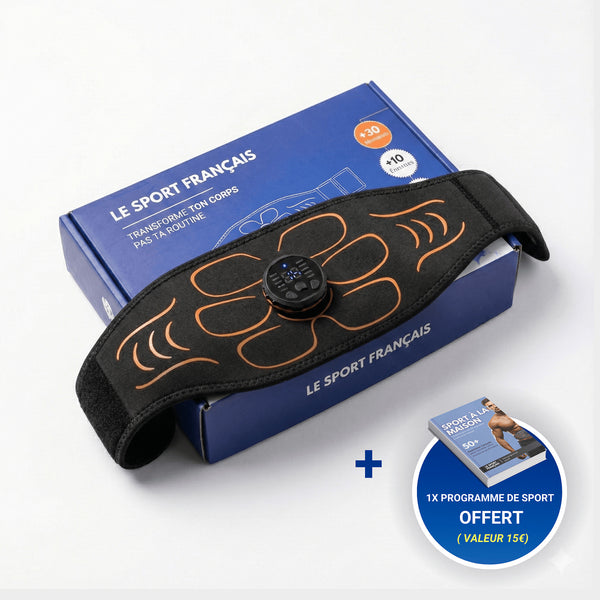
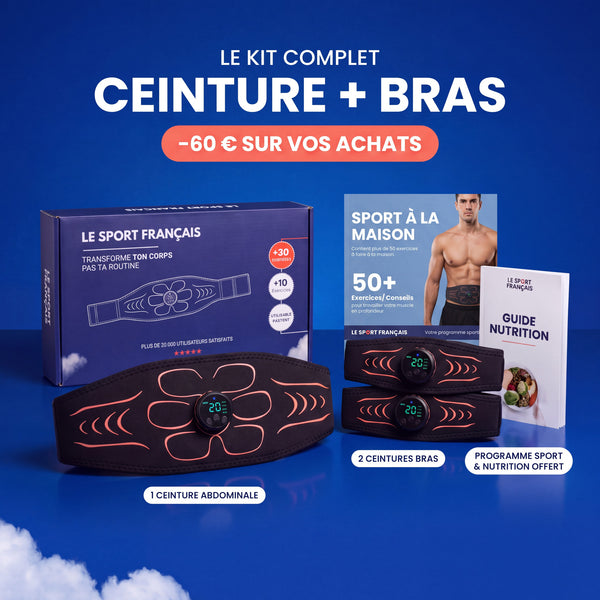
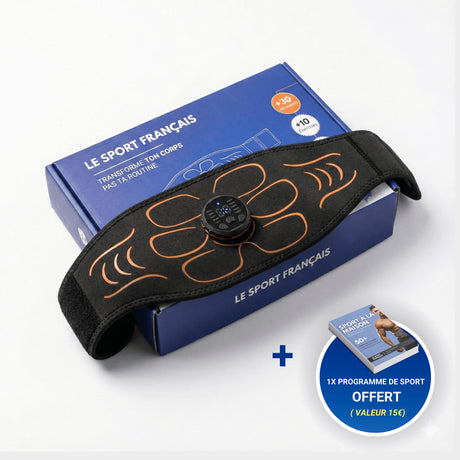
A strong core supports the spine and facilitates torso posture. The plank (3 sets of 30 seconds) and the "dead bug" (2 sets of 10 per side) are a good start. In addition to these exercises, and never in their place, the EMS abdominal belt (€59.99) can be used during your sessions to engage the abdominal wall through electrostimulation. If you are restarting core work after a pregnancy, first read our physio guide on postnatal abdominal exercises, which also covers baby carrying and posture.
Finally, move more outside of sessions: stand up every 45 to 60 minutes, walk at least 30 minutes a day, and vary your work positions.
Limitations, mistakes to avoid, and contraindications
A posture corrector does not strengthen your back. It does not cure a herniated disc, does not straighten scoliosis, and does not compensate for a poorly adjusted workstation.
Most common mistakes
- Wearing it all day: postural muscles rely on the device and lose endurance.
- Tightening too much: armpit compression, tingling in the arms, respiratory discomfort.
- Using it alone: without exercises, posture returns to its initial state upon removal.
- Wearing it during exercise: it blocks the natural movement of the shoulder blades.
Contraindications
Seek medical advice before use if you have scoliosis, a herniated disc, shoulder pathology (tendinopathy, capsulitis), recent back or shoulder surgery, skin irritation on the contact area, or acute pain that appeared without an obvious cause. The corrector is also not recommended during pregnancy without advice from your midwife or doctor, and in growing children without supervision.
Which posture corrector to choose? Our solution
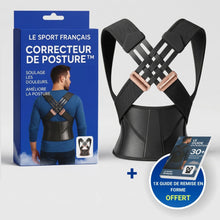
A good corrector must meet four requirements: precise adjustment, breathable material, support that guides without immobilizing, and enough discretion to be worn at the office. Our back and shoulder posture corrector was designed around these criteria. It is priced at €49 and available in six sizes, from S to XXXL, to fit most body types. This shoulder and back harness consists of adjustable elastic bands that go under the arms and cross over the back: you adjust the tension over the weeks, and the whole thing remains discreet under a t-shirt or shirt.
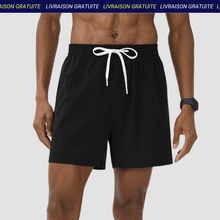
For your strengthening sessions, a fitted garment facilitates torso control. The men's compression top (€47.90) offers light, breathable support during training, without any traction on the shoulders: it does not replace the corrector, it accompanies it on workout days.
If you work on a keyboard and mouse all day, your wrists also take the strain of your posture. The wireless EMS wrist massager (€69.99, 10 modes and 29 intensities) can be used during a break at the office or while working from home to relax the forearm after several hours at a screen.
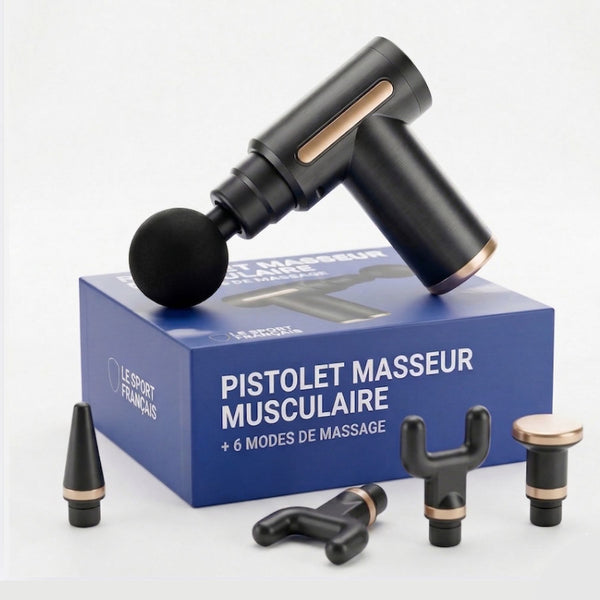
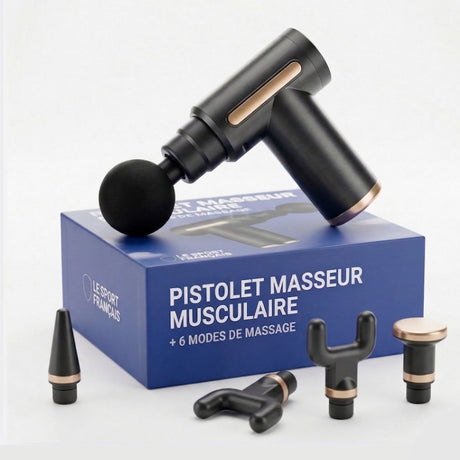
Finally, tension between the shoulder blades and in the traps is frequent in people starting to correct their posture. The muscle massage gun (€59, 5 speeds and 6 heads) helps relax these areas after a day of sitting; our massage gun user guide specifies areas to avoid.
Frequently asked questions
How long should you wear a posture corrector per day?
Start with 20 to 30 minutes per day, then gradually increase to a maximum of 1.5 to 2 hours, in several sessions, by the fourth week. Never wear it all day or at night. The goal is to reduce wearing time afterward, once your muscles and habits take over.
Is a posture corrector effective?
Alone, no: studies show that a postural garment does not mechanically change the position of the head and shoulders. However, it is useful as a reminder to become aware of your posture. It is upper back strengthening and stretching, practiced regularly, that produce measurable improvement.
Can you sleep with a posture corrector?
No. During sleep, you cannot react to proprioceptive feedback, and continuous traction on the shoulders can cause compression, tingling, and skin irritation. A corrector is only worn while awake, during static activities like screen work.
Does a posture corrector hurt?
It should not hurt. A light feeling of traction on the shoulders is normal at the beginning. Pain, persistent red marks, or tingling in the arms signal an overly tight adjustment or an inappropriate size. Loosen it, reduce wearing time, and if discomfort persists, stop and seek advice.
Does a posture corrector replace a physiotherapist?
No. The physiotherapist analyzes the causes of your posture, adapts exercises to your situation, and treats established pain. The corrector is a simple reminder tool that a professional may or may not integrate into their treatment. In case of persistent pain, consult before buying.
What to remember
- The posture corrector is a proprioceptive reminder tool, not a corset: it guides, it does not hold.
- Studies show that a postural garment alone does not change shoulder position; exercises do.
- Wear it gradually: 20 to 30 minutes per day the first week, 2 hours maximum by the fourth, always split.
- Pair it with 15 minutes of upper back strengthening, stretching, and core work, 3 times a week.
- Do not wear it at night, during sports, or continuously.
- In case of scoliosis, hernia, acute pain, or recent surgery, seek medical advice before use.
Conclusion
The posture corrector is neither a useless gadget nor a miracle solution. It is a learning tool: it signals to you when you are slouching and helps you anchor a better position, provided you wear it with moderation and exercise your muscles alongside it. Movement remains the true treatment for the back.
If you want to get started, our back and shoulder posture corrector offers precise adjustment and six sizes for comfortable everyday wear. And to complete your approach, our article on back pain, posture, and exercises for relief offers a simple routine to integrate into your week.
Sources
- Hamzelouie R., Arazpour M., Bahramizadeh M., Abdollahi I., Biglarian A., Shokri Y. (2025). Effectiveness of orthotic devices in the treatment of forward head posture: a systematic review. Journal of Rehabilitation and Assistive Technologies Engineering. journals.sagepub.com
- Christensen S.W.M., Johansson S.S., Jensen M.D., Jensen A.E., Knudsen T.H., Palsson T.S. (2022). Effect of a posture-cueing shirt on sitting posture during a functional task in healthy participants: a randomized cross-over study. Journal of Manipulative and Physiological Therapeutics. pubmed.ncbi.nlm.nih.gov
- Sepehri S., Sheikhhoseini R., Piri H., Sayyadi P. (2024). The effect of various therapeutic exercises on forward head posture, rounded shoulder, and hyperkyphosis among people with upper crossed syndrome: a systematic review and meta-analysis. BMC Musculoskeletal Disorders. link.springer.com
- Hayden J.A., Ellis J., Ogilvie R., Malmivaara A., van Tulder M.W. (2021). Exercise therapy for chronic low back pain. Cochrane Database of Systematic Reviews. cochranelibrary.com