








Do you get up from your chair with a stiff lower back, a tight neck, and shoulders hunched up to your ears? The link between back pain and posture is very real, but it is often misunderstood. It is not the "bad" position itself that damages your back: it is the fact of holding it for hours without moving. There is no such thing as a perfect posture: the best posture is the next one.
This guide provides you with 5 detailed exercises in the form of fact sheets, a 10-minute daily routine, a 4-week program, and an honest answer to the question that keeps coming up: in which cases does a back and shoulder posture corrector really help, and in which cases is it useless?
Why does posture cause back pain?
Most back pain is considered "common": it is not linked to a fracture, infection, tumor, or serious nerve damage. It affects the lower back (lumbar pain) or the neck (cervical pain), and is most often mechanical and muscular in origin.
Sedentary lifestyle and prolonged sitting
When sitting, the hip flexors remain shortened, the glutes are inactive, and the deep core muscles almost stop working. Over the months, this imbalance tires the passive structures of the spine (discs, ligaments) which must compensate for the lack of muscular support.
Screens and head forward
In front of a computer or smartphone, the head slides forward and the shoulders round. The neck and upper back muscles (trapezius, levator scapulae, rhomboids) must then constantly hold the head up.
What does science say about exercise for back pain?
On this point, the evidence is solid. The French National Authority for Health (HAS) reminds us that physical exercise is the primary treatment for common lumbar pain, that bed rest is not recommended, and that, in 90% of cases, common lumbar pain improves within 4 to 6 weeks (HAS, 2019, Management of the patient with common lumbar pain).
A Cochrane review of 249 trials and more than 24,000 adults concludes that exercise reduces pain and improves function in chronic lumbar pain compared to no treatment or usual care, with a low to moderate level of evidence and a more marked effect in the short term (Hayden et al., 2021, Cochrane Database of Systematic Reviews).
Approaches focused on core control have also been evaluated. A Cochrane review on Pilates reports low- to moderate-quality evidence of an effect superior to no intervention on pain and disability, in the short and medium term (Yamato et al., 2015, Cochrane Database of Systematic Reviews). For the upper back and neck, a meta-analysis of 22 studies shows that strengthening and stretching significantly improve forward head posture, rounded shoulders, and thoracic kyphosis (Sepehri et al., 2024, BMC Musculoskeletal Disorders).
The 5 exercises for back pain and poor posture
These five movements cover the three needs of a back that suffers from sitting: spinal mobility, core and glute strengthening, and upper back opening.
Exercise 1: Cat-Cow (spinal mobility)
- Position: on all fours, hands under shoulders, knees under hips, neutral spine.
- Breathing: inhale while gently arching your back and lifting your gaze (cow); exhale while rounding your back toward the ceiling, chin tucked in (cat).
- Sets: 2 sets of 10 slow cycles, approximately 4 seconds per phase.
- Errors to avoid: going too fast, forcing the range of motion in the lower back, holding your breath.
Exercise 2: Glute bridge (glutes and lower back)
- Position: lying on your back, knees bent, feet flat and hip-width apart, arms along your sides.
- Breathing: exhale while tightening your glutes and lifting your pelvis until your shoulders, hips, and knees are aligned; inhale while lowering back down vertebra by vertebra.
- Sets: 3 sets of 12 repetitions, holding for 2 seconds at the top.
- Errors to avoid: arching by pushing too high, pushing with the lower back instead of the glutes, letting the knees splay outward.
Exercise 3: Bird-dog (core stability)
- Position: on all fours, neutral spine, eyes looking at the floor.
- Breathing: exhale while simultaneously extending the right arm in front and the left leg behind, without going higher than the torso; inhale as you return.
- Sets: 3 sets of 8 repetitions per side, holding for 3 seconds.
- Errors to avoid: rotating the pelvis, arching the lower back, lifting the leg too high.
Exercise 4: Lunge psoas stretch (hip flexors)
- Position: right knee on the floor (on a cushion), left foot in front, torso upright, right glute contracted.
- Breathing: exhale while gently moving your pelvis forward until you feel the stretch at the front of the right hip; breathe calmly while holding.
- Sets: 2 sets of 30 to 40 seconds per side.
- Errors to avoid: arching the lower back to "go further," leaning the torso forward, holding your breath.
Exercise 5: Scapular retraction with chin tuck (upper back and neck)
- Position: sitting or standing, arms at your sides, palms facing forward.
- Breathing: exhale while squeezing your shoulder blades together and down, while pulling your head back as if making a double chin; inhale while releasing.
- Sets: 3 sets of 12 repetitions, holding for 5 seconds.
- Errors to avoid: shrugging shoulders toward the ears, lifting the chin, arching the lower back.
What 10-minute routine to do each day?
Consistency matters more than duration. Here is how to sequence the five exercises in ten minutes, ideally in the morning or at the end of the workday:
- 0 to 2 min: cat-cow, 2 sets of 10 slow cycles.
- 2 to 4 min: glute bridge, 3 sets of 12 repetitions.
- 4 to 6 min 30: bird-dog, 3 sets of 8 repetitions per side.
- 6 min 30 to 8 min: psoas stretch, 2 sets of 30 to 40 seconds per side.
- 8 to 10 min: scapular retraction with chin tuck, 3 sets of 12.
Add a simple rule during the day: get up every 45 to 60 minutes, walk for 2 minutes, and perform 10 scapular retractions.
4-week back pain program
This program is for people with no red flags (see below), whose pain is moderate and linked to a sedentary lifestyle.
Week 1: Learning the movements
10-minute routine, 5 days a week, with reduced sets (2 sets instead of 3). 20-minute daily walk.
Week 2: Establishing consistency
Full routine, 5 days a week. Add a plank on your knees, 3 sets of 20 seconds, at the end of the session. 25-minute walk. If you use a posture corrector, start with 20 to 30 minutes of wear per day during your sitting periods.
Week 3: Increasing the load
Increase to 15 repetitions on the glute bridge and 10 per side on the bird-dog. Regular plank, 3 sets of 30 seconds. Two more complete core sessions during the week, for example with our article on how to strengthen your abs without hurting your back. 30-minute walk.
Week 4: Consolidating
Full routine 5 days a week, plank 3 sets of 40 seconds, and a gentle endurance activity of 30 to 45 minutes twice a week (brisk walking, cycling, swimming). If nothing has changed after these 4 weeks, consult a professional.
When does a posture corrector help, and when is it useless?
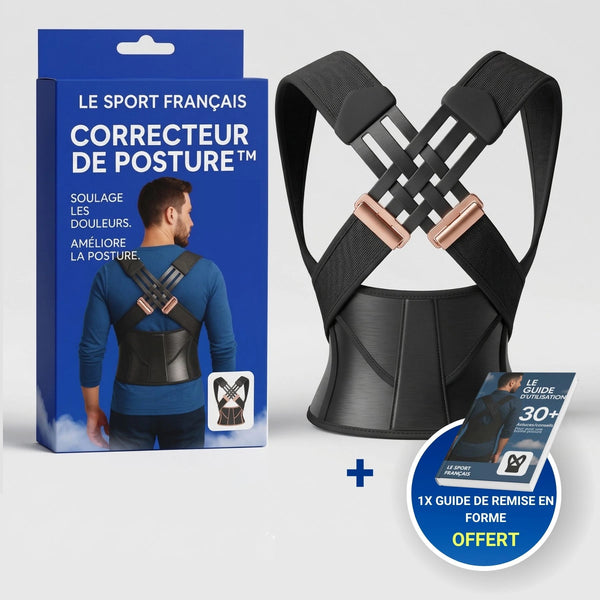
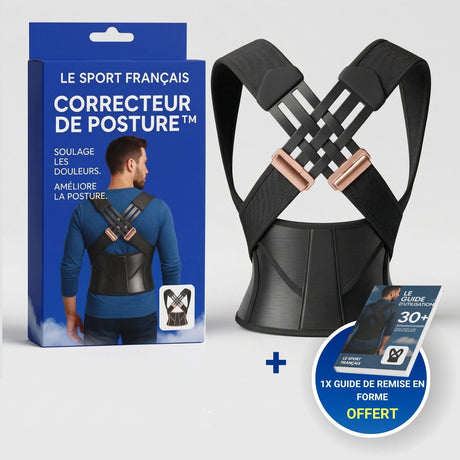
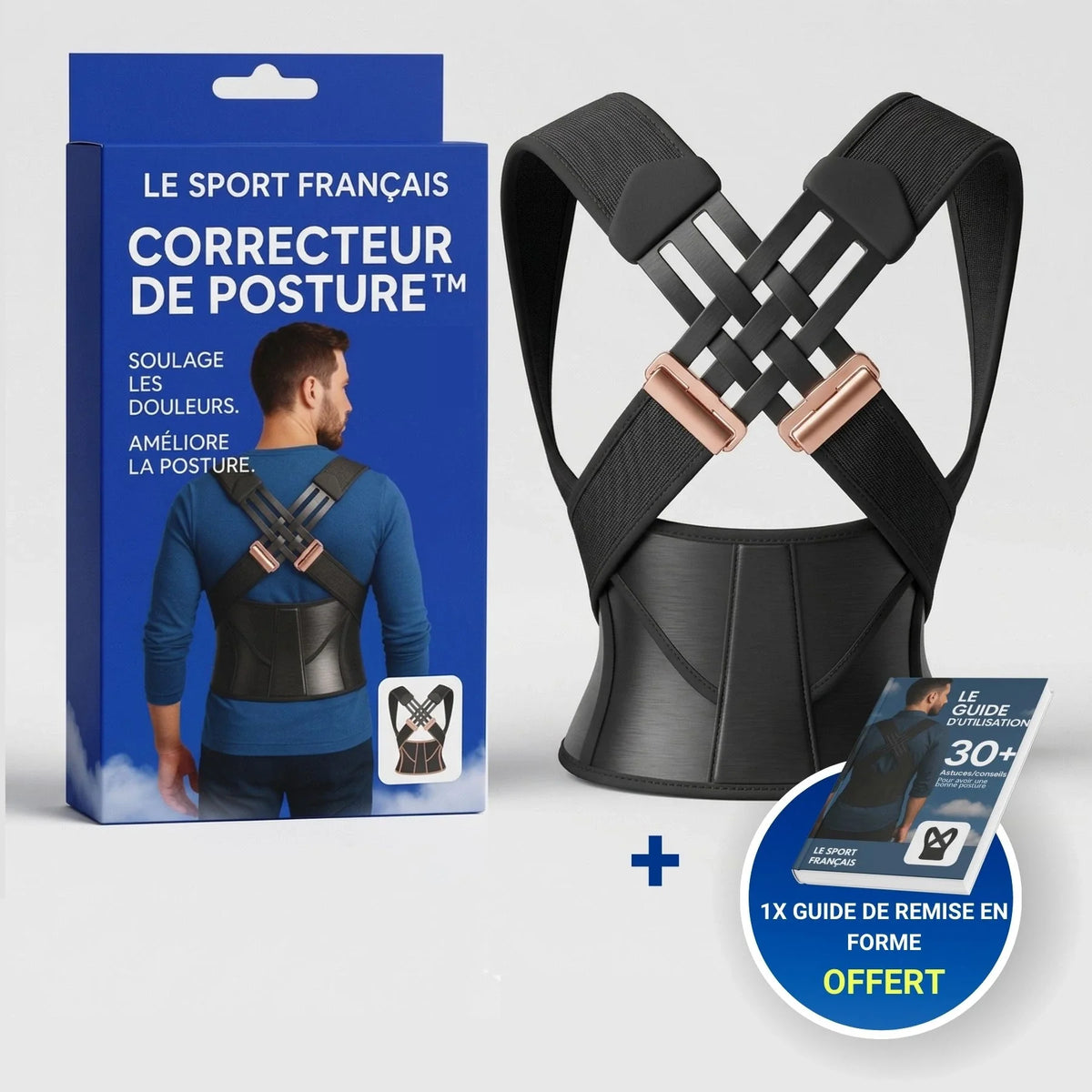
A posture corrector is an elastic harness that gently pulls your shoulders back and signals, through tension, when you are slouching. It is a reminder tool, not a treatment.
Situations where it helps
- Pain between the shoulder blades or in the trapezius linked to hours of screen time, in a person who slouches without realizing it.
- Routine learning phase: the proprioceptive reminder helps to transfer what you practice during exercise 5 to the office (see the benefits of a back posture corrector).
Situations where it is useless
- Pure lumbar pain: a shoulder corrector does not act on the lower back. It is the glute bridge, bird-dog, and walking that matter.
- Passive wear all day without exercises: the postural muscles rely on the device and the benefit disappears upon removal.
- Pain of non-postural origin (symptomatic herniated disc, sciatica, shoulder pathology): consult before any purchase.
The complete user manual, with the 4-week progressive wear calendar, can be found in our pillar guide on posture correctors: function, use, and results.
Limitations, errors to avoid, and contraindications
The exercises presented here are gentle, but they do not replace a diagnosis or supervised rehabilitation.
Most frequent errors
- Seeking pain: forcing the range of motion or continuing despite sharp pain. Moderate discomfort is acceptable; escalating pain is not.
- Stopping as soon as you feel better: the HAS recommends regular physical activity to limit recurrences.
- Neglecting the workstation: screen at eye level, forearms supported, feet on the floor, and above all, frequent changes of position.
Contraindications
Seek medical advice before starting if you have a known herniated disc with leg pain, diagnosed osteoporosis, recent back surgery, are currently pregnant (adaptation required), or have pain that appeared after a fall or impact. The posture corrector should be avoided in cases of shoulder pathology, skin issues in the contact area, or untreated scoliosis.
Warning signs: when to consult immediately?
The HAS lists "red flags" that should lead to a rapid medical consultation rather than a home exercise program (HAS, 2019). Consult without delay if you have:
- pain that does not depend on movement, that gradually worsens, or that wakes you at night;
- leg weakness, sensory disturbances, or difficulty urinating or controlling bowels;
- significant trauma (fall, accident) before the onset of pain;
- unexplained weight loss, fever, or a general alteration of health;
- a history of cancer, prolonged corticosteroid treatment, or a first episode before age 20 or after age 55.
Outside of these situations, and if the pain remains moderate, the HAS states that imaging is not immediately indicated and that a gradual return to movement is the best approach.
What equipment to choose for the exercises? Our solution
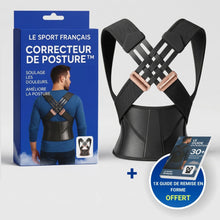
The program is done without equipment, but a few accessories help maintain the routine. For the upper back, our back and shoulder posture corrector (€49, six sizes from S to XXXL) is an adjustable elastic harness that is worn under clothing during your sitting periods, for 20 minutes to 2 hours per day at most, only as a supplement to the exercises.
To progress on core work starting in week 3, the silent, anti-slip abdominal wheel (€39.90) heavily engages the core. Reserve it for those already comfortable with a 40-second plank, starting on the knees with a reduced range of motion.
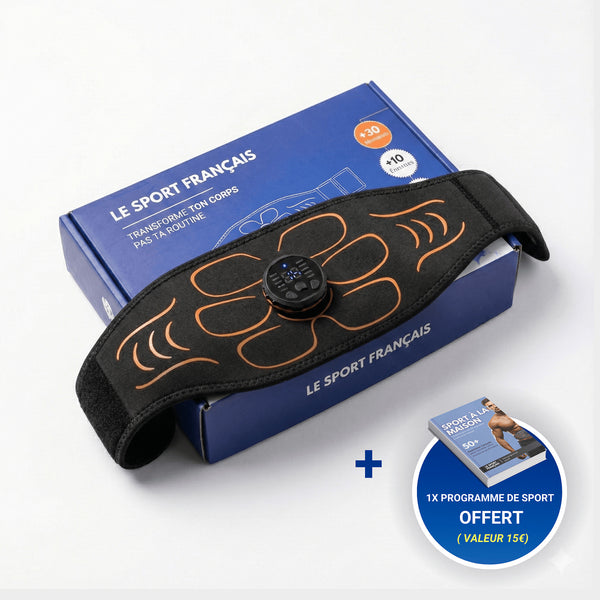
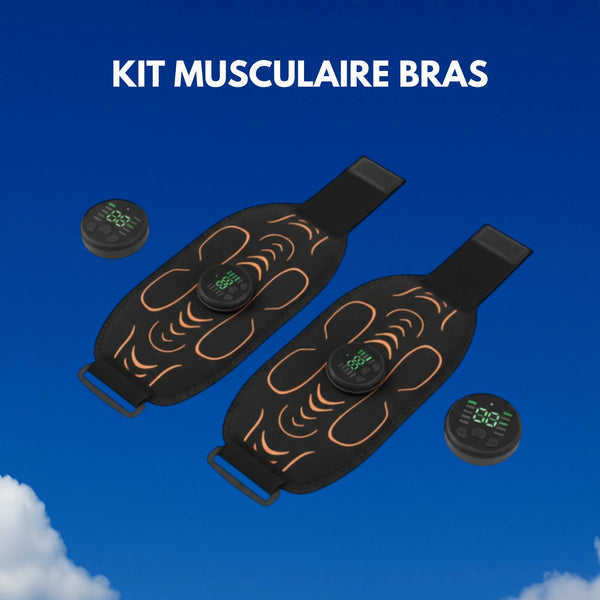
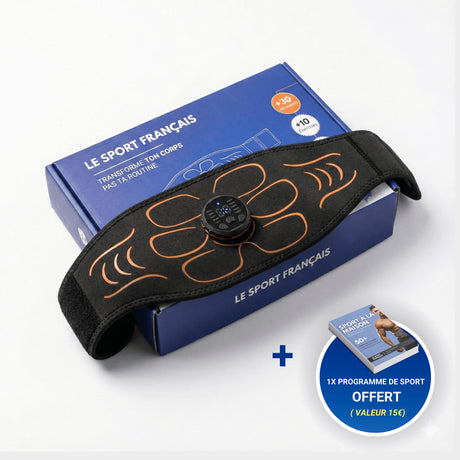
During your sessions, the EMS abdominal belt (€59.99) can be used as a supplement to engage the abdominal wall via electrostimulation.
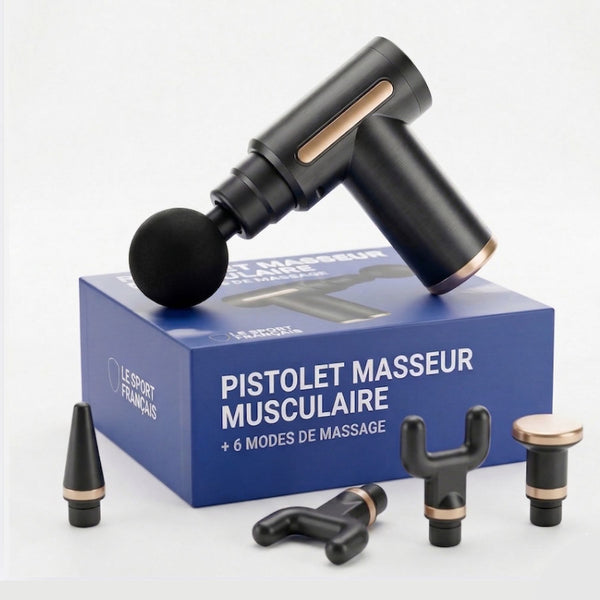
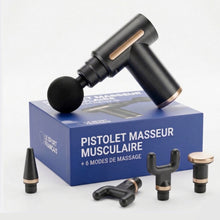
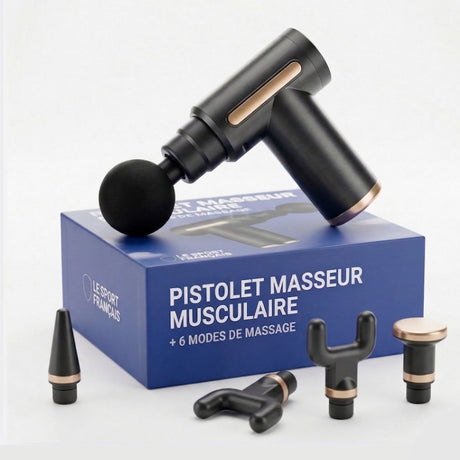
Finally, to relax the trapezius and glutes after a long day of sitting, the muscle massage gun (€59, 5 speeds, 6 heads) is used for 1 to 2 minutes per area. Our massage gun user guide specifies the areas to avoid, particularly the spine itself.
Frequently Asked Questions
Should you rest when you have back pain?
No, unless advised otherwise by a doctor. The HAS recommends maintaining activity and resuming movement as soon as possible, as prolonged rest promotes chronicity. Temporarily reduce intensity, keep walking and gentle exercises, then increase gradually.
How long to feel a difference?
According to the HAS, common lumbar pain improves within 4 to 6 weeks in 90% of cases. With a daily routine, many people notice less morning stiffness from the second week.
Does the posture corrector relieve back pain?
It can help with upper back and neck tension linked to screens by reminding you of your shoulder position. It does not act on lumbar pain and does not replace exercises. Studies on postural clothing show little mechanical effect on its own: it is the strengthening that produces a measurable change.
Can you do these exercises with a herniated disc?
A hernia discovered on an image without leg pain does not forbid these exercises, but the opinion of a doctor or physiotherapist is essential before starting. In case of radiating pain, weakness, or sensory disturbances, consult first: these are warning signs.
What to remember
- Common back pain is mainly linked to immobility and deconditioning, not to a specific "wrong" posture.
- Exercise is the reference treatment for common lumbar pain according to the HAS and the Hayden et al. (2021) Cochrane review.
- The 5 exercises (cat-cow, glute bridge, bird-dog, psoas stretch, scapular retraction) can be done in 10 minutes a day, without equipment.
- Follow the 4-week program by increasing the sets and adding walking and core work.
- The posture corrector helps for the upper back and neck during the learning phase; it is useless for lumbar pain and when worn alone.
- Night pain, leg weakness, urinary problems, fever, trauma: consult without delay.
Conclusion
A back that suffers from sitting needs to move, strengthen, and change positions more often first. The posture corrector has its place as a reminder for the upper back, provided it remains a supplement.
If you work on a screen and find yourself slouching, our back and shoulder posture corrector can support your first few weeks of the routine. To choose the right model, see our article on physiotherapist advice and 5 criteria for choosing a posture corrector.
Sources
- Haute Autorité de Santé (2019). Prise en charge du patient présentant une lombalgie commune. Recommandation de bonne pratique, fiche mémo. has-sante.fr
- Hayden J.A., Ellis J., Ogilvie R., Malmivaara A., van Tulder M.W. (2021). Exercise therapy for chronic low back pain. Cochrane Database of Systematic Reviews. cochranelibrary.com
- Yamato T.P., Maher C.G., Saragiotto B.T., Hancock M.J., Ostelo R.W., Cabral C.M., Menezes Costa L.C., Costa L.O. (2015). Pilates for low back pain. Cochrane Database of Systematic Reviews. cochranelibrary.com
- Sepehri S., Sheikhhoseini R., Piri H., Sayyadi P. (2024). The effect of various therapeutic exercises on forward head posture, rounded shoulder, and hyperkyphosis among people with upper crossed syndrome: a systematic review and meta-analysis. BMC Musculoskeletal Disorders. link.springer.com