





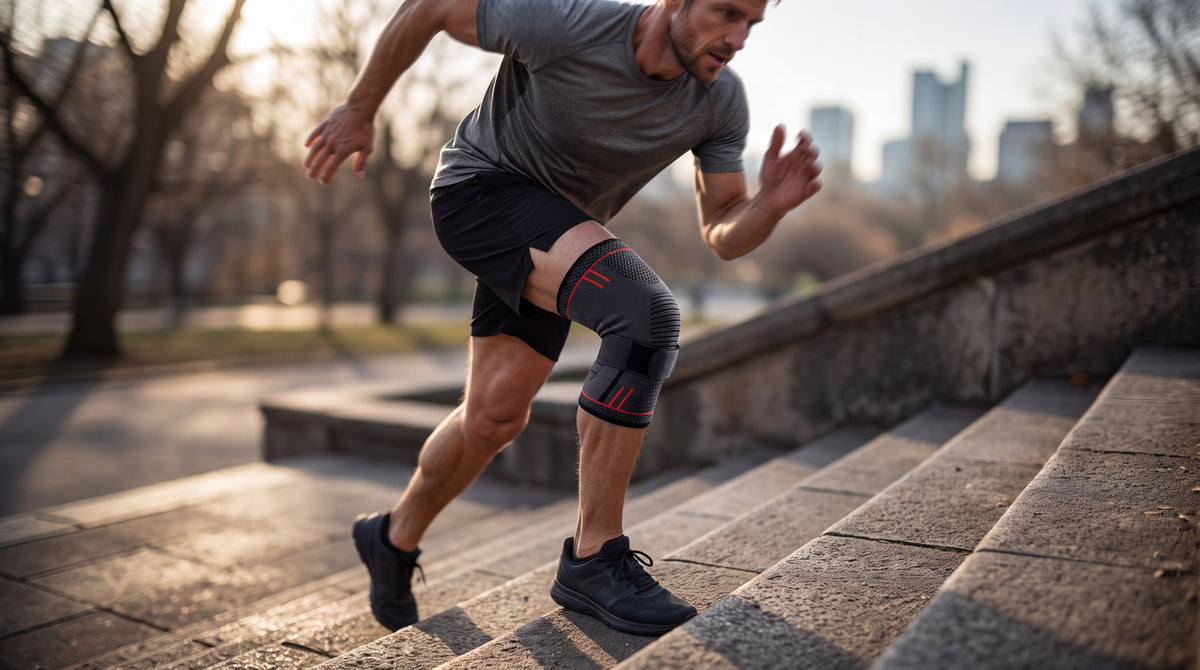
The sports compression knee sleeve is everywhere: on weekend runners, under squat bars, in hiking backpacks. Yet most people who wear one don't really know what it does or when it's useful. Should you put it on for every session? Only when your knee hurts? Plain sleeve or patella strap? In this guide, we give you straight answers: what a compression knee sleeve really delivers, what it will never do, how to choose the right size and the mistakes that turn a good accessory into a bad habit.
What exactly is a sports compression knee sleeve?
A compression knee sleeve is an elastic sleeve, made of neoprene or technical knit fabric, that wraps around the knee and applies gentle, even pressure to the tissues. It differs from two other families of supports: the rigid ligament knee brace (side hinges, prescribed after a severe sprain or surgery) and the patella band, a simple strap worn below the kneecap for tendinopathies.
Between these two extremes, the sports compression knee sleeve plays an intermediate role. It doesn't lock anything, doesn't correct alignment and doesn't stabilize a torn ligament. Its action relies on three mechanisms: compression of the soft tissues, local warmth and stimulation of the skin's receptors, known as proprioception. Some models add an adjustable strap at the kneecap or flexible side springs for firmer support, without becoming a medical brace. If you're new to this, our guide on how to choose sports compression explains where the knee sleeve fits compared with calf sleeves, socks and tights.
What a compression knee sleeve really does (and what it doesn't)
Let's start with what is best documented. A literature review published in 2017 in Physical Therapy in Sport examined the biomechanical and functional studies on knee sleeves. The most consistent effects concern improved proprioception, meaning the brain's ability to “sense” the knee's position in space, and a reduction in perceived pain, particularly in people with knee osteoarthritis. However, the authors stress that the quality of the evidence remains mixed and that the effects on performance in healthy athletes are modest or even non-existent.
In practice, here is what a compression knee sleeve can reasonably offer you:
- A feeling of stability and confidence, linked to the constant sensory feedback of the fabric on the skin, even though actual mechanical stability increases only very slightly.
- A warmer knee, faster, which makes warming up easier, especially in cold weather.
- Partial relief from mechanical pain (diffuse discomfort, stiffness, mild patellofemoral pain), through the pain-relieving effect of compression and warmth.
- A slight reduction in swelling after exercise, thanks to the drainage encouraged by the pressure.
And here is what it will never do, whatever some product pages claim: repair a ligament or a meniscus, protect you from injury during an impact or a twist, replace muscle strengthening, or make pain disappear when its cause hasn't been identified. A knee sleeve is a tool for comfort and proprioception, not a treatment.
When should you wear a compression knee sleeve?
This is the most frequently asked question, and the answer depends on the moment. Here are four situations, from the most relevant to the most debatable.
During exercise: the main use case
This is where the sports compression knee sleeve is most useful. In running, hiking with elevation gain, basketball, football or strength training (squats, lunges, leg press), it provides warmth, proprioception and confidence. It's especially popular with athletes returning after a break, people who feel discomfort on descents and strength athletes who string together heavy leg sets.
After exercise: for comfort, not for muscle recovery
Wearing it for one to two hours after a long run or a leg session can reduce the feeling of swelling and stiffness. However, the benefits of compression for muscle recovery itself mainly concern calf sleeves and full-coverage garments, as we explain in our article on compression and muscle recovery. For the knee, stay pragmatic: if it feels good, keep it on for a while; if not, take it off.
In everyday life and at work: sparingly
Wearing a knee sleeve all day only makes sense if you have an identified chronic issue (early osteoarthritis, after-effects of an injury) and your doctor or physiotherapist approves. In every other case, wearing it constantly brings nothing extra and can create a psychological dependence: you end up not daring to move without it.
At night: avoid it
Unless specifically prescribed, don't sleep in a compression knee sleeve. The leg is still, compression no longer has a functional role, and a slightly tight model can restrict circulation for several hours.
Sleeve, patella strap or side supports: which one should you choose?
The market offers three main designs of compression knee sleeve. The right choice depends on what you expect from it.
The simple compression sleeve
An elastic tube, with no strap or reinforcement. It's the lightest and most discreet option, ideal for road running, cycling or gym workouts. It provides warmth and proprioception, but no targeted kneecap support. If your knee is healthy and you're mainly looking for comfort, that's enough.
The knee sleeve with patella strap
This is the all-rounder par excellence. The compression sleeve gets an adjustable strap that runs below the kneecap and lets you fine-tune the pressure on the patellar tendon. It suits runners prone to patellofemoral pain, jumping sports and strength athletes who want firmer support without losing freedom of movement. The Le Sport Français compression knee sleeve with patella strap falls into this category: breathable sleeve, adjustable strap and hook-and-loop closure to find your pressure in seconds.
The knee sleeve with flexible side supports
It has flexible springs or stays along the sides of the joint. Lateral support is more pronounced, which is reassuring during changes of direction (team sports, technical trail running) or when returning after a mild sprain that has already been rehabilitated. The knee sleeve with side springs is the right compromise between a soft sleeve and a rigid brace. For sports with floor contact (volleyball, handball), a padded EVA knee sleeve adds protection for the kneecap against direct impacts.
And depending on your sport?
Road running and trail: a thin, breathable sleeve, or a patella strap if you know the pain of descents; avoid thick neoprene, which makes you sweat and slips. Strength training and CrossFit: 5 to 7 mm neoprene for warmth on heavy squats. Team and racket sports: flexible side supports, plus EVA padding if you often fall on your knees. Mountain hiking: a patella strap for long descents, in a size that stays comfortable for several hours. Returning after 45 or early osteoarthritis: a soft sleeve, only during activity, alongside strengthening work approved by a health professional.
How do you choose your size and compression level?
Size is the most overlooked criterion, yet it's what makes the difference between an effective knee sleeve and one that slips or cuts off circulation. The four-step method:
- Measure your thigh circumference about 10 cm above the center of the kneecap, standing, with your leg straight and relaxed.
- Measure your calf circumference about 10 cm below the center of the kneecap. Some brands use knee circumference at the center of the kneecap instead: always follow the manufacturer's size guide.
- Between two sizes, go for the larger one for long wear or endurance efforts, and the smaller one for firm support on short strength sets.
- Test the fit: the knee sleeve should stay in place through about ten deep knee bends without rolling, and you should be able to slide a finger under the top edge without forcing. Tingling, cold toes or a purplish mark at the bottom of the thigh are signs the model is too tight.
As for material, neoprene retains more heat and suits strength sports and short sessions; breathable technical knit is better for running, hiking and extended wear.
Protocol: 4 weeks to use your knee sleeve wisely
A compression knee sleeve gives the best results when it supports strengthening work rather than replacing it. The quadriceps, hamstrings and hip muscles are the knee's true stabilizers. This protocol is for athletes who feel mild mechanical discomfort and want to get back to training pain-free. In case of acute pain, significant swelling or a knee that “gives way”, see a doctor first.
Week 1: get used to it
Wear the knee sleeve only during your sessions, 2 to 3 times a week, 30 to 45 minutes maximum, on low-impact activities: cycling, brisk walking, swimming, mobility. Every day, add 3 sets of 12 seated knee extensions (3-second hold) and 3 sets of 12 glute bridges. Goal: identify the movements that cause discomfort and confirm the size.
Week 2: load progressively
Same frequency, sessions of 45 to 60 minutes. Reintroduce partial squats (no deeper than 90° of knee bend) and static lunges, 3 sets of 10 per leg, with the knee sleeve on. After the session, do 10 minutes of quadriceps and hamstring stretches, without the knee sleeve.
Week 3: back to your main sport
Resume your main activity with the knee sleeve, at 60 to 70% of your usual intensity. Keep two strength sessions a week: full squats if pain allows, step-ups onto a step, banded hip abductions. Still wear it only during exercise and for the hour after.
Week 4: reduce dependence
Leave the knee sleeve off for easy sessions (warm-ups, low impact) and keep it for demanding sessions or long outings. If your knee feels as comfortable without it as with it on light sessions, you're on the right track: the knee sleeve becomes a safety accessory for big efforts, not a daily crutch. If you run, our 4-week running training plan combines very well with this protocol.
Mistakes to avoid and contraindications
The most common mistakes we see among our customers and on running forums:
- Choosing a size too small “so it's nice and tight”. Excessive compression hinders venous return, numbs the leg and ends up stiffening the knee.
- Masking pain to carry on as before. Pain is a signal. If it persists beyond two to three weeks despite relative rest, look for the cause with a professional; don't cover it up with a sleeve.
- Wearing it all the time. Without a medical reason, continuous wear brings nothing extra and reinforces the idea that your knee is fragile.
- Believing it protects against a sprain. A soft knee sleeve doesn't prevent a violent twist. For pivoting sports with a history of ligament injury, only a prescribed rigid brace makes sense.
- Neglecting care. Neoprene that is never washed loses its elasticity: hand wash in lukewarm water after each intense use and dry flat, away from radiators.
Some situations mean you should avoid knee compression or seek medical advice: circulatory disorders (arterial disease, known venous thrombosis), wounds or skin infections in the area, unexplained swelling, diabetes with loss of sensation in the lower limbs, allergy to neoprene or latex. After knee surgery, follow only the instructions of your surgeon and physiotherapist. For osteoarthritis pain, the Haute Autorité de santé points out in its 2022 sheet on physical activity in peripheral osteoarthritis that appropriate exercise (strengthening, mobility, proprioception) is the first-line treatment, with braces and supports being complementary treatments. So a knee sleeve never excuses you from moving.
Frequently asked questions
Is it good to wear a knee sleeve all day?
No, unless advised by a doctor. Wearing it permanently brings no extra benefit compared with wearing it during exercise; it can irritate the skin, restrict circulation and make you dependent on it. Keep it for your sessions and the hour after.
Compression knee sleeve or patella band?
The patella band targets only the tendon below the kneecap: useful for diagnosed patellar tendinopathy, useless for warmth or overall proprioception. The knee sleeve with patella strap combines both functions and remains more versatile.
Can you run with a compression knee sleeve?
Yes, as long as it's thin, breathable and the right size. It won't make you run faster, but it can make your runs more comfortable if you have mild mechanical discomfort. If pain appears or gets worse while running, the knee sleeve isn't the answer: see a doctor. And if you have both knee discomfort and shin splints, read our article on compression socks and shin splints.
How long does a compression knee sleeve last?
With two to three uses a week and proper care, expect 6 to 12 months before its elasticity noticeably decreases. When it no longer stays in place during knee bends, replace it.
Should you wear a knee sleeve on both knees?
Only if both knees are affected. Fitting a healthy knee “for symmetry” has no proven benefit. In heavy strength training, some lifters do it for warmth and comfort: that's a personal choice, not a necessity.
Conclusion: the knee sleeve is a tool, not a crutch
A well-chosen, properly worn sports compression knee sleeve does its job: it warms the joint, improves your sense of the knee's position in space and eases mild mechanical discomfort during exercise. It doesn't cure anything, doesn't protect against trauma and never replaces strong quadriceps. Wear it during your sessions, in the right size, alongside strengthening work, and take it off as soon as you no longer need it.
If you're looking for a versatile model for running, hiking and strength training, the Le Sport Français compression knee sleeve with patella strap covers the vast majority of needs. To go further, read our guide on how long to wear compression garments and our summary on compression and recovery.
Sources: literature review on the biomechanical and functional effectiveness of knee sleeves, Physical Therapy in Sport, 2017 (PubMed); Haute Autorité de santé, “Prescription d'activité physique – Arthroses périphériques” sheet, July 2022.