








You have just received your massage gun, and the same question comes up at every session: how long should you really apply it to each area? Thirty seconds, two minutes, five minutes? The advice found online is contradictory, and most overlook the essential: the right duration depends on the muscle, the timing (before or after exertion), and your goal. In this guide, you will find precise durations per area, a minute-by-minute protocol, and what studies actually say, without exaggerated promises.
Why duration matters more than power
A massage gun delivers rapid percussions (1,800 to 3,200 per minute on most models) that cause the muscle and fascia to vibrate. The desired effect is twofold: a temporary increase in local blood flow and a decrease in perceived tension. These effects appear from the first minute, then plateau. Insisting for ten minutes on the same spot does not provide ten times the benefit; it mainly increases the risk of irritation, bruising, and soreness the next day.
The question "how long per area" is therefore more important than that of maximum speed. A large muscle like the quadriceps requires more time than a thin muscle like the forearm, and muscle priming before training is not handled like recovery in the evening. Remember this principle: short duration and regular frequency almost always beat a long and rare session.
How long per area depending on the muscle?
Here are the durations we recommend for a classic recovery session, with light to moderate pressure and a slow sweeping motion. These benchmarks are deliberately cautious: they remain within the range used by studies without exceeding the thresholds beyond which sensitivity increases.
- Quadriceps (front of the thigh): 90 seconds to 2 minutes per thigh. This is the largest muscle in the body; it tolerates the round head and medium speed well.
- Hamstrings (back of the thigh): 60 to 90 seconds per thigh, avoiding the hollow of the knee.
- Glutes: 60 to 120 seconds per side. Thick area, often tense in runners and people sitting all day.
- Calves: 60 to 90 seconds per calf, staying on the fleshy part of the muscle and never on the Achilles tendon or behind the knee.
- Back (paravertebral muscles): 60 seconds on each side of the spine, never passing over the vertebrae themselves.
- Traps and shoulders: 30 to 60 seconds per side, light pressure, flat or cushioned head. Stop well before the neck.
- Pectorals and arms: 30 to 45 seconds per area; these are smaller muscles that respond quickly.
- Sole of the foot: 30 to 60 seconds per foot, soft head, low speed.
Add up these durations: a complete lower body session takes 8 to 10 minutes, the whole body 12 to 15 minutes. This is the ceiling we advise: beyond that, the return diminishes and the risk of sensitivity increases. For the details of areas to avoid (spine, joints, neck, bony prominences), our massage gun user guide reviews them one by one.
Before or after sports: does the duration change?
Yes, and this is the point that most guides neglect. Before a session, the goal is to wake up the muscle and gain a bit of range of motion, not to relax it deeply. Application that is too long before explosive effort (sprints, jumps, heavy lifting) can give a feeling of "soft" legs. Therefore, we stick to 30 to 45 seconds per muscle group, at low or medium speed, for a total of 3 to 5 minutes.
After sports, the goal becomes recovery: you can go up to 60-120 seconds per area, moderate pressure, slow movement. But watch the timing. A study published in 2024 in the Journal of Athletic Training tested five minutes of massage gun on the calves immediately after intense exercise: no measurable benefit compared to passive rest, and even a slight increase in the sensation of soreness in the following hours. Concretely, if your muscles are still "burning" right after a very hard session, wait 1 to 3 hours (or until the next day) before massaging them, and start gently.
For maintenance, outside of training days, 30 to 60 seconds per area is enough to release the tension of remote work or a long day standing. This short format is the one that can be repeated most often.
Minute-by-minute protocol: how long per area according to your goal
Here are three typical, timed sessions to follow exactly as they are. Set a timer on your phone: it is the best guarantee of not exceeding the durations.
Session A: muscle priming before training (4 minutes)
- 0:00 – 0:30: right quadriceps, speed 1-2, fast sweep from top to bottom.
- 0:30 – 1:00: left quadriceps, same setting.
- 1:00 – 1:30: right glute, then 1:30 – 2:00 left glute, speed 2.
- 2:00 – 2:30: right hamstring, 2:30 – 3:00 left hamstring, speed 1-2.
- 3:00 – 3:30: right calf, 3:30 – 4:00 left calf, speed 1, round head.
Finish with 2 to 3 minutes of active warm-up: the gun does not replace the warm-up, it complements it.
Session B: lower body recovery after running or legs (10 minutes)
- 0:00 – 2:00: right quadriceps (1 min) then left (1 min), speed 2-3, round head, slow movement.
- 2:00 – 4:00: glutes, 1 minute per side, speed 3, round or large ball head.
- 4:00 – 6:00: hamstrings, 1 minute per side, speed 2.
- 6:00 – 8:00: calves, 1 minute per side, speed 1-2, staying in the middle of the muscle.
- 8:00 – 9:00: iliotibial band (outer side of the thigh), 30 seconds per side, light pressure: this area is sensitive.
- 9:00 – 10:00: soles of the feet, 30 seconds per foot, soft head.
This session repeats, in a shortened version for home, the order of muscles used in a randomized trial published in 2025 in Frontiers in Public Health. It pairs well with wearing compression sleeves for the legs in the hours that follow if you are looking to limit the sensation of heavy legs.
Session C: upper body and back maintenance (5 minutes, non-training days)
- 0:00 – 1:00: traps, 30 seconds per side, speed 1, flat head, never on the neck.
- 1:00 – 3:00: muscles on each side of the spine, 1 minute per side, two fingers away from the vertebrae.
- 3:00 – 4:00: pectorals, 30 seconds per side, outer part only.
- 4:00 – 5:00: forearms and triceps, 30 seconds per area, low speed.
For specific painful spots ("knots"), the technique changes: head placed without moving, light pressure, 10 to 15 seconds, 10 seconds of pause, three repetitions maximum. Never more than 45 cumulative seconds on the same point.
Which speed and head to choose for each area?
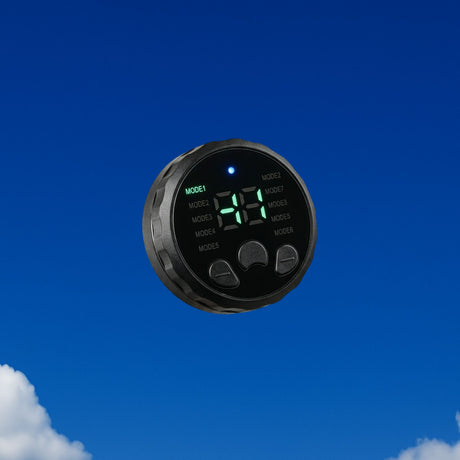
Duration only makes sense when associated with a consistent setting. On a five-speed gun, consider levels 1 and 2 as priming and maintenance speeds, level 3 as the standard recovery speed, and levels 4 and 5 as reserved for very large muscles (quadriceps, glutes) for accustomed users. Increasing speed should never compensate for a duration that is too short: you gain more by respecting 60 to 120 seconds at medium speed than by crushing the muscle for 20 seconds at full power.
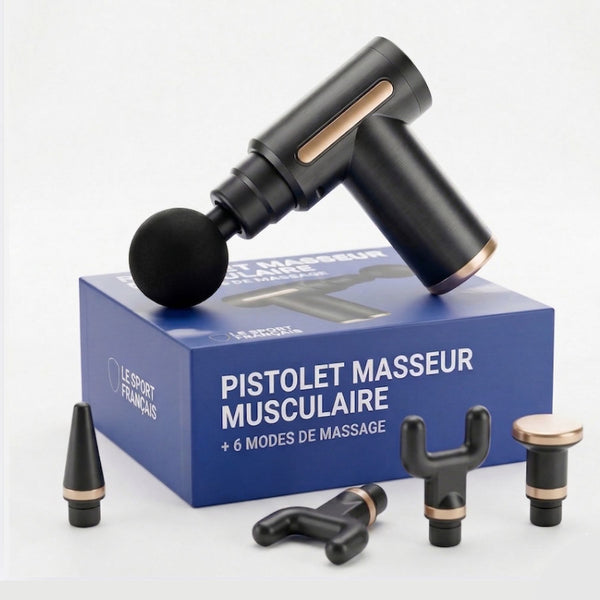
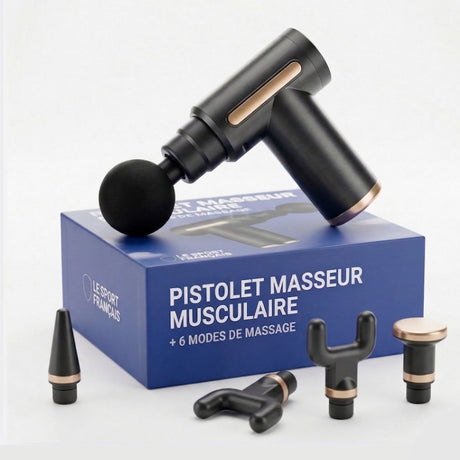
As for heads: the soft round head is versatile for large muscle groups; the flat head is suitable for dense areas (back, pectorals); the U-shaped head frames the Achilles tendon or runs along the spine without touching it; the conical head is reserved for precise points, at low speed and for a few seconds. Simple rule: the smaller and harder the head, the shorter the duration should be.
What studies say about application duration
Research on massage guns is still young, but a few well-constructed trials allow us to derive concrete benchmarks.
On flexibility: in a study published in the Journal of Sports Science and Medicine (Konrad et al., 2020), five minutes of percussion on the calf (2.5 minutes per muscle head) increased ankle flexion range by about 18% in sixteen amateur athletes, with no loss of maximum strength. An application of 2 to 3 minutes per area thus gains mobility without "turning off" the muscle.
On frequency: a crossover trial published in 2025 in the Journal of Bodywork and Movement Therapies (Sams et al.) compared eight protocols. The most effective for lower body flexibility consisted of just 60 seconds per muscle group, three times a week, with speed increased progressively from one session to the next. The authors note that it takes 5 to 10 minutes after the massage to observe the full mobility gain.
On post-exercise recovery: the randomized trial by Li et al. (2025, Frontiers in Public Health) compared, after heavy squats, percussive massage sessions of 2.5 or 4 minutes per site to static stretching. The massage reduced pain better and restored knee range of motion at 48 hours, and the long protocol gave the best results on explosive strength. Important nuance: these sessions were performed on young athletes, under supervision, with a soft head. They are not a model to replicate every evening, but they show that 2 to 4 minutes per large muscle remain reasonable for a real recovery session.
Finally, the limit already mentioned: applied immediately after exhaustive effort, the gun showed no advantage over rest in the study by Leabeater et al. (2024). The global message is consistent: short to moderate durations, regularity, and a bit of a delay after very intense sessions.
Limits, errors to avoid, and contraindications
A massage gun does not treat an injury and does not replace a physical therapist or the basics of recovery (sleep, hydration, nutrition). The most frequent errors are related to duration and placement:
- Staying too long on a spot: beyond 45 cumulative seconds on the same point, the risk of bruising or irritation increases significantly.
- Massaging an area already painful to pressure: sharp pain, local heat, or swelling are signs of inflammation. Do not touch it for 48 hours and consult if it persists.
- Passing over bones, joints, and the spine: knee, elbow, ankle, vertebrae, protruding shoulder blade, and skull are excluded, regardless of duration.
- The neck and the front of the throat: never, because of the vessels and nerves that pass through there. Stop at the traps.
- Combining several long sessions on the same day: to massage twice during the day, keep a short session (3-5 minutes) and leave 24 hours before working the same muscle again for a long time.
Certain situations require a doctor's advice before any use: pregnancy, pacemaker, circulatory disorders (significant varicose veins, history of phlebitis), anticoagulant treatment, recent fracture or sprain, osteoporosis, diabetic neuropathy, cancer currently under treatment. In these cases, no duration is "safe" without medical validation. If your discomfort is mainly posture and lower back related, our exercises for back pain and poor posture are a more appropriate complement than prolonged massage.
Frequently asked questions
Can you use a massage gun every day?
Yes, provided you stick to short sessions (5 to 10 minutes in total, 30 to 60 seconds per area) and reserve the long sessions (up to 2 minutes per large muscle) for training days. If an area becomes sensitive to the touch, let it rest for 48 hours.
How long on the calves exactly?
60 to 90 seconds per calf in recovery, 30 seconds before running. Stay on the fleshy part of the muscle, round head, low to medium speed, far from the Achilles tendon and the hollow of the knee.
How long on the back and lower back?
About 60 seconds on each side of the spine, with the flat head or the U-shaped head that frames the vertebrae without touching them. Low speed, light pressure, and never in case of acute pain or undiagnosed sciatica.
Does massaging longer give more results?
No, not proportionally. Mobility gains appear from 60 seconds and plateau around 2 to 3 minutes per area; beyond that, you mainly increase the risk of irritation. Several short sessions per week are better than one occasional long session.
Should you massage before or after running?
Both, with different durations: 30 seconds per muscle before, 60 to 120 seconds per area after, preferably one to three hours after an intense run. If you are a beginner, our 4-week running plan for beginners already includes recovery days.
Conclusion: the right duration is the one you respect
Massage gun and "how long per area" boil down to a few easy-to-remember figures: 30 seconds per muscle before effort, 60 to 120 seconds per area after, never more than 45 cumulative seconds on a specific point, and a complete session that does not exceed 15 minutes. Set a timer, choose the right head, stay on the muscle and not on the bone: three short sessions a week are better than one long one.
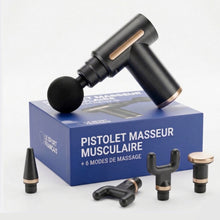
If you are looking for a simple device to set up to apply this protocol at home, the Le Sport Français muscle massage gun offers five speeds and six interchangeable heads, enough to cover every area described here. For tired feet, the heated shiatsu foot massager takes over. To go deeper, read our complete massage gun user guide and our 10 core exercises to do at home.