







Running compression socks are everywhere on starting lines, from 10Ks to marathons. Yet, between brand promises and the skepticism of some runners, it’s hard to know what they really bring to the table. Do they improve performance? Do they reduce muscle soreness? Should you wear them during exercise, after, or both? In this guide, we take stock of their real benefits based on the most recent meta-analyses, and then provide a concrete protocol to help you use them at the right time and choose the right pair.
How does a running compression sock work?
A compression sock exerts graduated pressure on the leg: stronger at the ankle, lighter moving up toward the calf. This gradient follows the same principle as medical compression stockings, but with generally more moderate pressure levels (often between 15 and 25 mmHg for sports, up to 20-30 mmHg for recovery-oriented models).
This progressive tightening serves three objectives. The first is to facilitate venous return: by compressing the superficial veins, the sock helps blood return to the heart, complementing the calf's natural "pump" that activates with every stride. The second is to limit muscle oscillation: with every ground impact, the calf vibrates, and these micro-vibrations, repeated thousands of times, contribute to fatigue and muscle micro-lesions. The third is purely practical: foot support, friction reduction, and, on padded models, cushioning under the arch and heel.
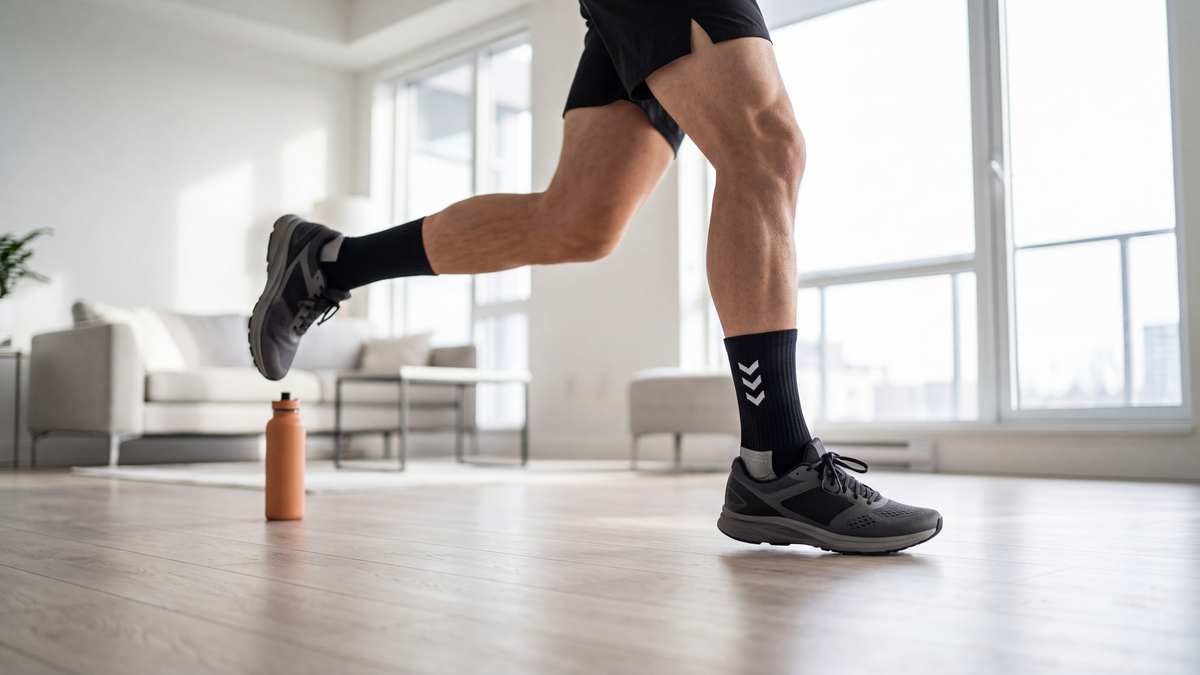
You must distinguish between two families of products. High socks (up to the knee) and sleeves apply compression to the entire calf. Mid-calf socks, which are shorter, mainly compress the ankle and arch and focus more on support and comfort: they do not claim to replace full calf compression, and it is important to know this before buying.
Do compression socks improve running performance?
That is the question everyone asks, and the honest answer is: no, not in any measurable way. A systematic review with meta-analysis published in 2025 in the Journal of Sport Rehabilitation (Telles et al.) scrutinized 28 trials, including 16 included in the statistical analysis of 284 runners. Result: wearing compression socks while running does not alter heart rate, blood lactate, running speed, time to exhaustion, or perceived exertion compared to conventional socks. You can view the abstract of this study on PubMed.
This finding aligns with that of a highly cited review published in 2016 in Sports Medicine by Engel, Sperlich and their colleagues, which analyzed 55 studies and 788 participants: no significant improvement in running performance, from the 400m to the marathon. Chrono gains come from training, sleep, and nutrition, not from textiles.
That does not mean compression socks are useless during exercise. Many runners report a feeling of "tighter" legs, fewer calf vibrations, and better comfort on long runs. These benefits are subjective, variable from person to person, and science does not translate them into seconds saved.
What are the real benefits for recovery?
This is where running compression socks truly keep their promises. The same Engel et al. (2016) review notes that wearing compression garments reduced post-run or post-ride muscle soreness in eight studies. The meta-analysis by Brown et al., published in 2017 in Sports Medicine based on 23 studies, concludes a "small but very likely" benefit of compression on recovery (effect size 0.38), with more marked effects on muscular strength recovery, notably between 2 and 8 hours and then beyond 24 hours after exercise. The details of this analysis are available on the Sports Medicine journal website.
A concrete example: a study published in 2012 in the Journal of Strength and Conditioning Research on 22 rugby players showed that wearing compression during the 24 hours following exercise significantly reduced soreness at 48 hours and slightly improved (about 2%) the 3 km time in the subsequent test, compared to a placebo. The effect remains modest, but consistent with all the data.
The takeaway: the benefits of compression socks are primarily demonstrated after exercise, regarding the feeling of soreness, perceived fatigue, and the return of strength. During running, the effect is essentially a matter of comfort.
During or after exercise: when should you wear your compression socks?
Based on the studies, here is a simple rule that we apply ourselves.
- During a run: wear them if they provide you with comfort, support, or a feeling of less "shaken" calves, especially on long runs, hills, and trail running. Do not expect direct performance gains. If you don't like the tightness, run with classic running socks: you won't lose anything.
- After a run: this is the most useful time. Put on a clean pair within the hour after finishing and keep them on for 2 to 4 hours, or even all day after a long effort (half-marathon, marathon, run of more than 90 minutes). It is in this window that the reduction of soreness and fatigue is best documented.
- Traveling: car or train rides after a race, or days spent standing or sitting for long periods: compression limits the feeling of heavy legs and ankle swelling.
- At night: to be avoided with sports compression socks. Lying down, venous return happens naturally, and prolonged tightening without movement provides no benefit. Only medical compression stockings prescribed by a doctor should be worn at night in specific cases.
How to choose your running compression socks?
A poorly chosen compression sock is at best useless, and at worst uncomfortable. Four criteria really matter.
Height: mid-calf, high, or sleeve
The mid-calf sock is suitable for runners looking primarily for ankle support, cushioning under the foot, and breathable fabric without annoying seams. Our Le Sport Français Padded Mid-Calf Compression Running Socks are designed for this daily use: training, 10Ks, city runs. For full calf compression, geared towards recovery or long distances, choose high socks like our 20-30 mmHg High Compression Socks, or a sleeve if you prefer to keep your usual socks.
Pressure level in mmHg
For exercise, light to moderate pressure (15-20 mmHg) is enough and remains comfortable for several hours. For recovery, a pressure of 20-30 mmHg is more effective, provided it is well tolerated. Beyond 30 mmHg, you enter the medical realm: these levels should only be worn with a prescription.
Size: the most often neglected criterion
For a high sock or a sleeve, size should first be chosen based on calf circumference at the widest point, then by shoe size. A sock that is too large provides no compression; one that is too small cuts off circulation and leaves a painful mark under the knee. Measure yourself in the morning, before your leg swells.
Material and padding
Favor a technical blend (polyamide, elastane, possibly merino wool) that wicks away sweat and maintains its elasticity wash after wash. Targeted padding at the heel and forefoot reduces friction and blisters, which is often more decisive in a marathon than the level of compression itself.
4-week protocol to integrate compression into your routine
Compression should not become a crutch you can't live without. Here is a progressive protocol that allows you to objectively test what it brings you.
- Week 1 – Discovery: wear your compression socks only after your sessions (2 to 3 hours), without changing your training. Record your soreness level out of 10 every evening.
- Week 2 – Long run: add wearing them during your longest run of the week. Observe how your calves feel (vibrations, fatigue) and whether or not there is discomfort from the tightness.
- Week 3 – Cross-test: do two similar sessions (e.g., two 45-minute runs at the same pace): one with compression after exercise, one without. Compare your soreness notes the next day. This is your own study in real-world conditions.
- Week 4 – Routine: keep what worked for you. For most runners, this boils down to wearing compression after every intense session and during runs of more than 90 minutes, then leaving it in the drawer the rest of the time.
Combine this routine with the basics of recovery: hydration, appropriate meals after exercise (see our guide on sports nutrition before and after exercise), sufficient sleep, and, if needed, a few minutes of massage gun on the calves. Compression is a complement, never the foundation.
Limitations, mistakes to avoid, and contraindications
Let's be clear about what compression socks don't do: they won't make you run faster, they don't replace a structured training plan, and they don't heal an established injury. Periostitis or Achilles tendonitis first require medical advice and an adaptation of training load; compression can at best provide temporary comfort.
Most frequent mistakes: choosing size by shoe size alone without measuring the calf, wearing a pair too tight to the point of feeling tingling, wearing them at night, or wearing them damp after a run in the rain (maceration, blisters). Compression socks should be washed after every use and replaced as soon as they have lost their elasticity, generally after 6 to 12 months of regular use.
Certain situations require caution, or even prohibition, without prior medical advice: peripheral artery disease, diabetes with loss of foot sensitivity, unstable heart failure, skin infection or wound on the leg, or recent venous thrombosis. If you have any doubts, talk to your doctor or pharmacist before using compression, even for sports. Finally, in case of pain, numbness, or skin discoloration while wearing them, remove the sock immediately.
Frequently Asked Questions
Are compression socks useful for a beginner runner?
They are not essential. A beginner primarily needs good shoes, gentle progression, and rest. If you feel marked calf soreness after your first runs, a pair worn after exercise can improve your comfort. To structure your start, follow our 4-week running training plan for beginners.
How long should you wear compression socks after a run?
Between 2 and 4 hours after a standard session, and until the end of the day after a half-marathon or marathon. Take them off to sleep. Beyond the day, sports compression offers no demonstrated additional benefit.
Compression socks or sleeves: what to choose?
The sleeve leaves the foot free and is easy to remove during the day, but it does not compress the foot or ankle. High socks offer continuous compression from foot to knee, which is more consistent for recovery. Our Full Leg Compression Sleeve is an option for those who also want to cover the knee and thigh.
Can you wear compression socks for a marathon?
Yes, provided you have tested them on several long runs during training. Never test a new pair on race day. The real benefit comes at the finish: put on a clean pair for the trip back and the hours that follow.
Do compression socks prevent cramps?
No solid study proves this. Cramps during exercise depend primarily on neuromuscular fatigue, intensity, and training. A better-supported calf may fatigue a bit less quickly at the end of a race, but compression is not a cramp remedy.
Conclusion: real benefits, provided you use them correctly
Running compression socks will not improve your personal best, and any promise to the contrary should make you suspicious. On the other hand, when worn after exercise and properly adjusted, they reduce muscle soreness and the feeling of heavy legs, which is confirmed by several meta-analyses. During running, they remain a personal comfort choice, particularly appreciated over long distances.
If you are looking for a versatile pair for your daily training, with support, cushioning, and breathability, check out our Padded Mid-Calf Compression Running Socks. For recovery after your long runs, supplement with high compression. And to strengthen calves and core muscles that handle the miles better, read our 10 effective core exercises to do at home.