







Pilates has been recognized for decades as one of the most effective approaches for sculpting and toning the abdominal core — not by seeking hypertrophy like traditional weight training, but by developing control, depth, and precision in muscular work. This guide provides you with the most targeted Pilates exercises for a flat stomach, organized into a progressive program.
Why Pilates is particularly effective for a flat stomach
Pilates primarily targets the transversus abdominis — the deep muscle that compresses the abdomen and keeps it flat. This is the reason why Pilates practitioners often have a flatter stomach after 6 to 8 weeks of practice, regardless of weight loss. By strengthening this deep muscle, Pilates creates a kind of natural muscular corset that holds the abdominal organs in place and provides a toned silhouette. Unlike classic crunches that work the rectus abdominis (a superficial muscle), Pilates exercises systematically recruit the deep muscles as a priority.
Breathing — the foundation of everything
Pilates breathing is the key to everything else. In Pilates, exhaling automatically activates the transversus via the diaphragm. Every time you exhale, your transversus contracts. By coordinating the most difficult movements with the exhale, you maximize the work of the transversus during those moments. This is why Pilates exercises, when performed correctly with the proper breathing, are much more effective than the same movements performed while holding your breath.
Exercise 1: The Stomach Series
This is the core Pilates series for a flat stomach. It consists of five sequential exercises: Single Leg Stretch, Double Leg Stretch, Single Straight Leg, Double Straight Leg, and Criss-Cross. All are performed with the shoulders lifted and the head off the floor, which maintains constant abdominal contraction throughout the series. It is the Pilates equivalent of a complete 10-minute abdominal workout.
Exercise 2: The Criss-Cross
The most effective Pilates exercise for the obliques. Lying down, hands behind your head, elbows open. Lift your shoulders and head. Bring your right knee toward your chest while rotating your torso to the left (left shoulder toward the right knee). Simultaneously, the left leg extends. Alternate fluidly and slowly, holding for 2 seconds in each rotation position. The oblique activation in this exercise is among the highest measured for any abdominal exercise.
Exercise 3: The Teaser
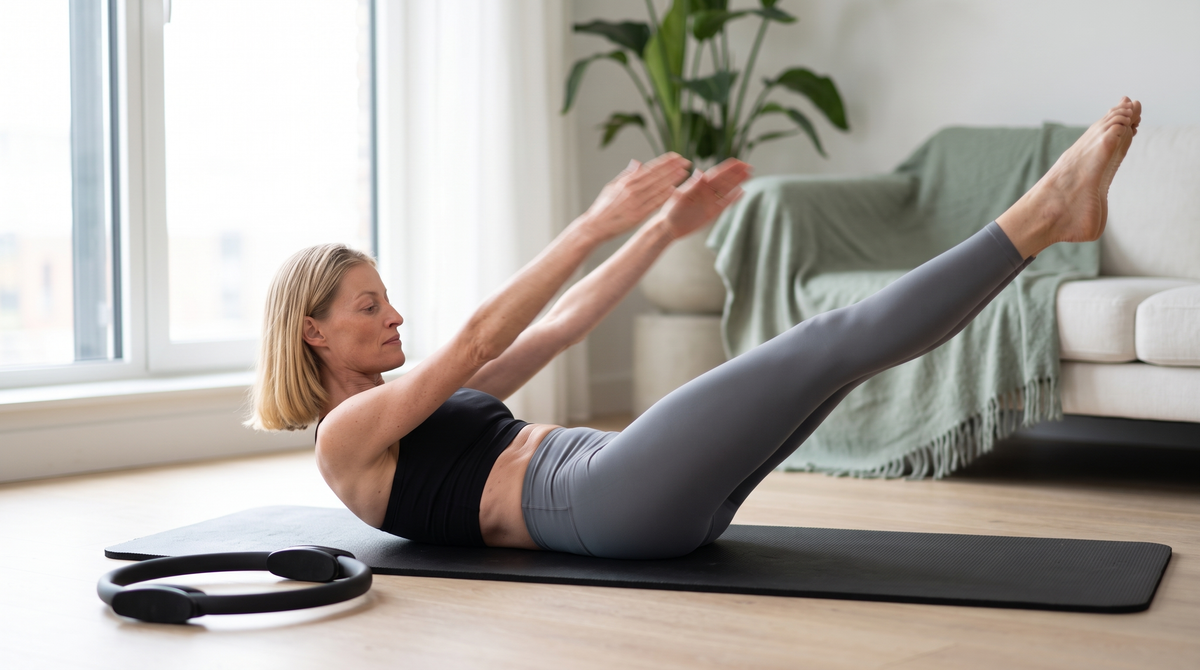
The signature exercise of Pilates. Lying on your back, legs at 45 degrees. Simultaneously lift your torso and legs until you form a V with your body, arms stretched toward your knees. Maintain balance on your tailbone. Lower slowly. This is the most difficult abdominal exercise in the Pilates repertoire, simultaneously engaging the transversus, rectus abdominis, obliques, and hip flexors. Introduce it gradually after 4 to 6 weeks of practice.
Exercise 4: Rolling Like a Ball
Seated, knees bent, heels close to your glutes, hands on your ankles or shins, back rounded. Lift your feet and balance on your tailbone. Roll backward onto your shoulder blades (not your head), then return to a balance. This spinal massage movement intensely activates the transversus, which must maintain the curvature of the back throughout the roll. 6 to 10 repetitions.
6-Week Flat Stomach Pilates Program
Weeks 1-2 (beginner): 3 sessions of 25 min. Breathing (10 reps), Pelvic Curl (8 reps), Chest Lift (10 reps), Single Leg Stretch (10 each side), Double Leg Stretch (8 reps), Spine Stretch (8 reps), Swimming (20 alternations). Weeks 3-4 (intermediate): 4 sessions of 30 min. Hundred (x70), Roll-up (x8), Leg Circles (x8 each side), full Stomach Series, Rolling Like a Ball (x8), Side Kick Series (x10). Weeks 5-6 (advanced): 5 sessions of 35 min. Hundred (x100), Roll-up (x10), Rocker (x6), full Stomach Series, Teaser beginner version (x5), Swan Dive (x6), Side Bend (x8).
Nutrition and Pilates for a flat stomach
Pilates alone will not melt abdominal fat if your diet creates a caloric surplus. For the muscles sculpted by Pilates to become visible, a slight caloric deficit is necessary. According to the recommendations of the ANSES, a deficit of 300-400 kcal/day combined with sufficient protein intake is the optimal combination for losing fat while preserving the muscle mass developed through Pilates.
Combining Pilates and EMS
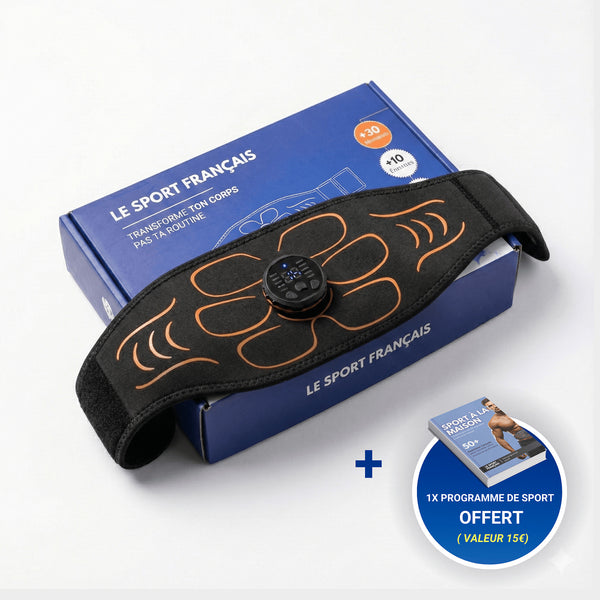
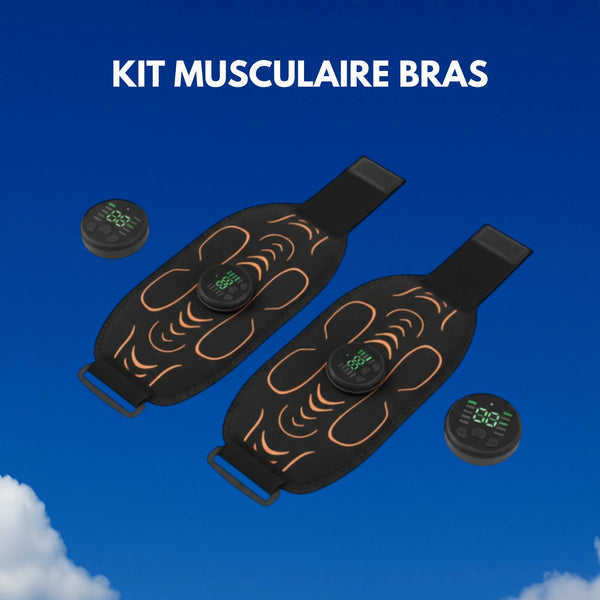
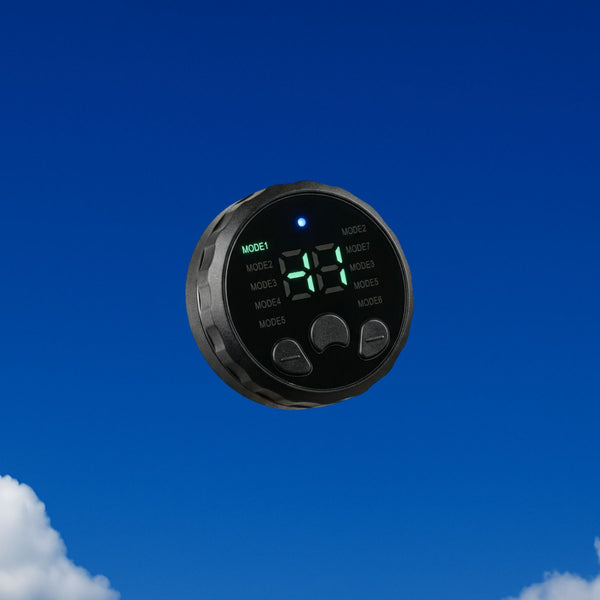
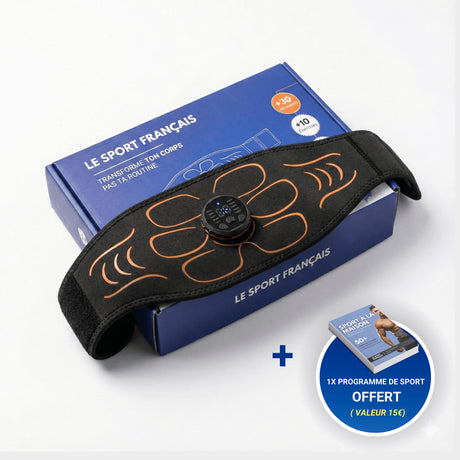
The Le Sport Français EMS Abdominal Belt is a remarkable complement to Pilates. While Pilates develops neuro-muscular awareness and control of the deep muscles, EMS amplifies the recruitment of these muscles and extends their stimulation to times when you are not practicing. Worn for 20-30 min on days without Pilates, it maintains stimulation of the abdominal core 7 days a week.
To go further, check out our guides Pilates at home: complete guide for beginners and Beginner Pilates: 8 simple exercises.