

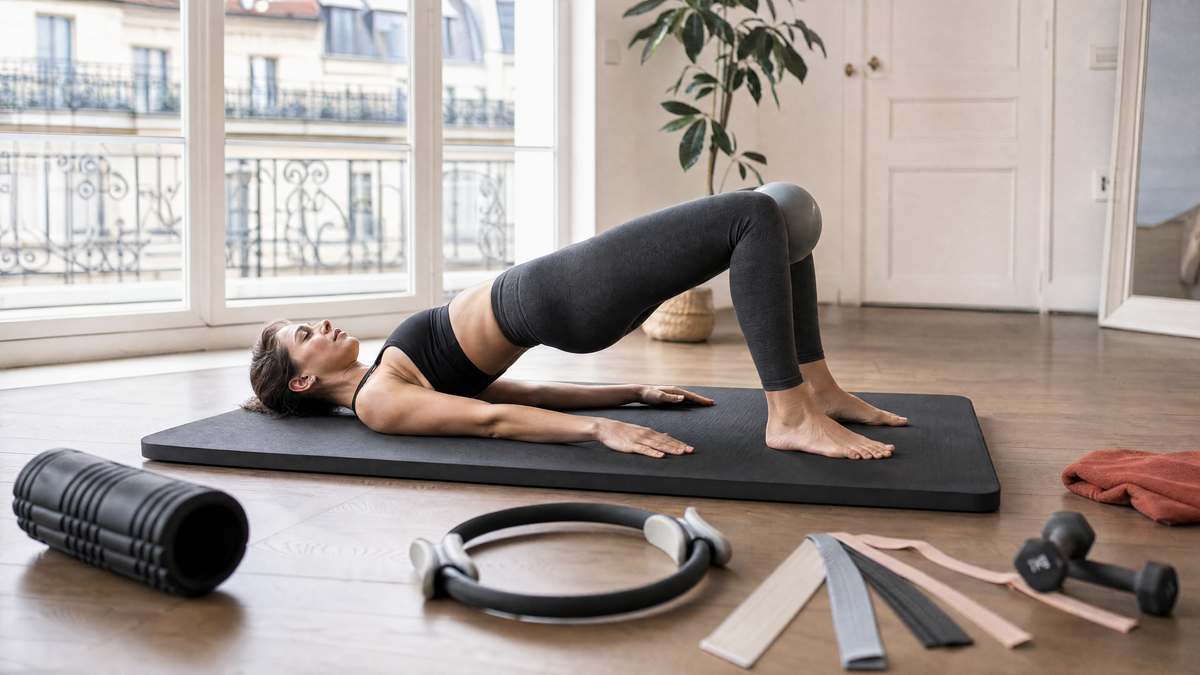
What home Pilates equipment is truly essential, and what can wait? Between “all-in-one” kits costing over 200 euros and videos where everyone uses a ring, a ball, and a roller, it’s easy to believe you need to invest heavily before your first session. The reality is simpler: mat Pilates was designed to be practiced with almost nothing, and small equipment is used primarily for variety, correction, and progress. In this guide, we review every accessory, what it actually provides, how to choose it, what budget to set based on your goal, and in what order to introduce it over four weeks.
Do you really need equipment to do Pilates at home?
No, not to start. The fundamental exercises of the method (the Hundred, the Roll Up, the Single Leg Stretch, the bridge, the side plank) are practiced using body weight on a mat. Clinical research confirms this: in a systematic review by Wells et al. published in PLoS One in 2014, covering 14 randomized controlled trials, Pilates programs significantly improved pain and functional capacity in people suffering from chronic lower back pain, and most of these protocols relied on floor exercises with very few accessories.
Equipment becomes useful at three specific times: when you lack sensory feedback (the ring or ball provides a tactile cue to activate deep muscles), when you plateau (bands and small dumbbells add measurable resistance), and when you want to work on mobility or recovery (the foam roller). Therefore, you buy to solve a concrete problem, not to "have the full kit." If you are a beginner, start with exercises without equipment, then come back to this guide when the question of equipment really arises.
Home Pilates equipment: the mat, the only truly essential purchase
A thin 3 to 4 mm yoga mat is suitable for standing postures, but quickly becomes uncomfortable for Pilates, where you spend a lot of time on your back, on your side, and pressing your vertebrae into the floor during roll-ups. The mat is therefore the first and often the only mandatory purchase. The criteria that matter:
- Thickness: 6 to 10 mm. Below this, the spine and tailbone suffer during rolling movements; beyond 12 to 15 mm, the mat becomes unstable for balance and core work.
- Grip: a non-slip side for the floor, a textured surface for your skin. A mat that slides breaks your concentration and fatigues your wrists.
- Dimensions: at least 180 x 60 cm; 185 to 200 cm if you are taller than 1.80 m (5'11").
- Material: TPE or natural rubber for a good balance of density and durability; cheap PVC flattens in a few months and retains odors.
Expect to pay, as a rough guide, between 20 and 60 euros. This is the only item where we advise against entry-level products: it is your interface with the floor during every minute of every session.
The 5 small accessories that change a session
Once the mat is chosen, five accessories cover almost all the needs of a home practice. We rank them by order of priority for a beginner.
The Pilates ring (Magic Circle)
A flexible circle 35 to 38 cm in diameter with two padded handles that you press between your hands, knees, or ankles. Its immediate tactile feedback helps recruit the adductors, the inner arms, and above all the core (transverse abdominis, pelvic floor). Choose a medium resistance, pads on both sides, and never crush the ring completely: 20 to 30% of maximum pressure is enough. Our 10 exercises with the Pilates ring detail safe positioning.
The small 20 to 25 cm soft ball
Not to be confused with the large 55 to 75 cm Swiss Ball, which is bulky at home. Inflated to two-thirds, the small ball slips under the pelvis, between the knees, or under the shoulder blades: it acts as a support for sensitive backs and provides light instability to activate deep muscles. Check for an "anti-burst" rating. It is the cheapest and one of the most versatile accessories.
Elastic and resistance bands
Flat bands and loop bands add progressive resistance to arm, leg, and glute movements. Science is reassuring regarding their effectiveness: a meta-analysis by Lopes et al. published in SAGE Open Medicine in 2019 (8 studies) found no significant difference in strength gain between elastic resistance training and conventional weight training, for both upper and lower limbs. Get a set of three resistances (light, medium, heavy) rather than just one band. For assisted pull-ups, rowing, and lunges, a thick elastic resistance band (7 to 16 kg) complements thin bands very well.
The foam roller
The roller serves as an unstable support for floor exercises and a self-massage tool. Regarding the latter, evidence is solid: a meta-analysis by Konrad et al. in Sports Medicine in 2022 (11 studies, 290 participants) reports a moderate effect of foam rolling practiced regularly for more than four weeks on the range of motion of the hamstrings and quadriceps. Choose a medium density (a very hard roller is discouraging), smooth rather than bumpy, and 90 cm if you want to use it as a support.
Small 1 to 2 kg dumbbells
In Pilates, you use light weights and high control: a pair of 1 kg and a pair of 2 kg are enough for arm series and standing exercises. Prefer neoprene, which doesn't slip in sweaty hands.
Which Pilates equipment to choose according to your goal?
Not everyone needs everything. Here are our priorities based on why you are turning to Pilates.
Relieving back and lumbar pain
8 to 10 mm mat, small ball (under the pelvis or between the knees to protect the lower back), and roller for thoracic mobility. The ring comes later, never first: pressure on the adductors can trigger pelvic pain.
Strengthening the core and stomach
Mat, ring, and bands. The ring between the knees or ankles amplifies transverse activation during the Hundred and Criss-Cross; elastic bands load rotations. An honest reminder: strengthening the core improves posture and alignment, but no accessory will "spot-reduce" belly fat; your overall energy balance determines that.
Postpartum recovery
Thick mat, small ball, and light bands, nothing else for the first few weeks. No exercises with the ring between the legs or loads on the abdominals before your pelvic floor checkup and approval from your midwife or physical therapist. Our postpartum abdominal guide details the recovery timeline.
Increasing mobility and improving recovery
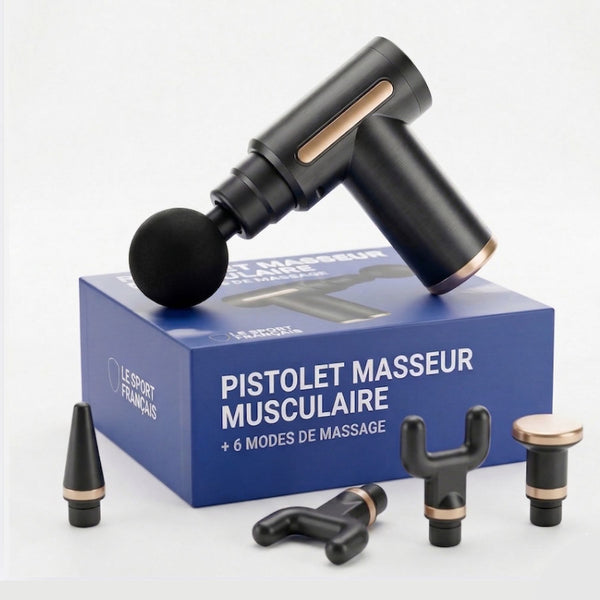
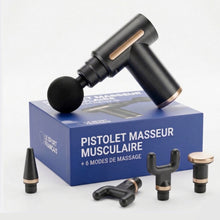
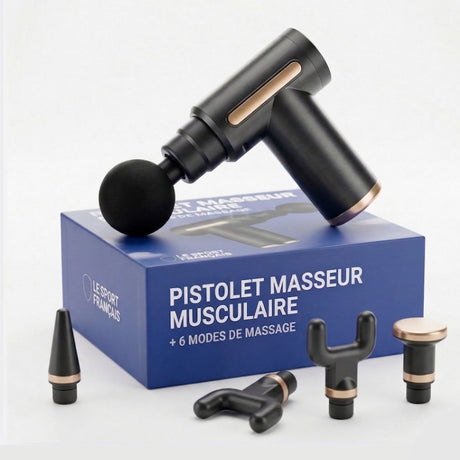
Roller first, then light bands for assisted stretches. If you run or lift weights, a massage gun complements the roller for hard-to-reach areas (calves, deep glutes), but does not replace it for back mobility.
Toning legs and glutes
Loop bands (medium and strong), ring, small dumbbells for standing exercises. This is the only goal for which a wall bar or a mini-reformer provides a real benefit, after several months of regular mat practice.
How much does a complete home Pilates kit cost?
The prices below are approximate ranges observed in 2026 on the French market. What matters is the logic of the tiers.
- Tier 0: 0 euros. A folded towel on the carpet, a cushion as a ball, a bathrobe belt for stretches. Sufficient to test the method for two weeks.
- Tier 1: 30 to 60 euros. A good 6–10 mm mat and a small ball. This is the minimal kit, with which 80% of exercises in a beginner's session can be performed.
- Tier 2: 80 to 150 euros. Add the ring, a set of three bands, and a roller. You now cover the entirety of a group mat Pilates class.
- Tier 3: 150 euros and more. Small dumbbells, wall bar with elastics, then mini-reformer. Reserved for those who have practiced regularly for six months or more.
What not to buy first: the large Swiss Ball (bulky, rarely used in classic Pilates), "12-accessory" kits where half remain in the closet, and machines costing several hundred euros bought before you’ve committed to three months. The best equipment is the kind you use three times a week. You will find mats, rings, balls, rollers, and bars in the Le Sport Français Pilates range.
4-week program: gradually integrating equipment
Three 25–35 minute sessions per week, a rest day between them, and a progression that follows the arrival of each accessory. If you already have all the equipment, still follow this order: sensation before resistance.
- Week 1: mat only. Three 25-minute sessions: lateral breathing (3 minutes), pelvic tilts, Hundred with knees bent (5 sets of 10 breaths), Single Leg Stretch (2 sets of 10), bridge (2 sets of 12), plank on knees (3 sets of 20 seconds), cat stretch. Goal: activate the core without compensating with the neck and hips.
- Week 2: add the small ball. Three 30-minute sessions. Ball between the knees for bridges and the Hundred, ball under the pelvis for controlled leg circles, ball under the shoulder blades for upper back roll-ups. The ball is for feeling, not for forcing.
- Week 3: ring and bands. Three 30–35 minute sessions. Ring between the ankles for the Hundred and Double Leg Stretch (20–30% pressure), ring between the hands for lying arm series (3 sets of 12), medium band for seated rowing (3 sets of 12) and loop leg extensions (2 sets of 15 per side). Tension in the neck is the signal to reduce resistance.
- Week 4: roller and full session. Three 35-minute sessions. Five minutes of rolling at the start of the session (calves, quadriceps, thoracic spine, 45–60 seconds per area), then the sequence from weeks 1–3 performed without pause, with two exercises lying on the roller (arms in a cross, breathing). Finish with 3 minutes of stretches using the light band.
After four weeks, you will know which accessories you really use: that is when, and not before, dumbbells, a bar, or a mini-reformer deserve consideration.
Errors to avoid and contraindications
Pilates is a gentle practice, but equipment introduces risks that product labels rarely mention.
- Pressing the ring completely creates adductor cramps and can aggravate sports hernias or pubic symphysis pain (frequent in late pregnancy and postpartum). Never place the pads on the kneecap or ankle bone.
- Using a damaged band: a cracked band can snap under tension and hit your face. Inspect them monthly and replace them at the slightest doubt.
- Rolling on the lower back with the foam roller: you roll the thoracic back, glutes, thighs, and calves, never directly the lumbar spine or a joint.
- Adding weight before mastering: dumbbells or a strong band on a poorly controlled movement transfers the load to the neck and hip flexors instead of the core.
Seek advice from a healthcare professional before using equipment in case of a recent herniated disc or acute lower back pain (no rolling or rollers on the back), pregnancy (no exercises on the stomach, caution with the ring between the legs), postpartum before your pelvic floor checkup, severe osteoporosis (no repeated spinal flexion), recent hip replacement (no pressure on adductors), or blood clotting issues or significant varicose veins (no deep self-massage). In case of sharp pain, tingling, or dizziness during an exercise, stop and consult a doctor.
Frequently Asked Questions
What is the essential home Pilates equipment for beginners?
A 6–10 mm mat and, optionally, a small 20–25 cm soft ball. Everything else (ring, bands, roller, dumbbells) can wait until you have practiced regularly for two to four weeks and identified what you are missing.
Is a yoga mat enough for Pilates?
To test it out, yes. To practice regularly, a 3–4 mm yoga mat becomes uncomfortable under the spine during rolling movements; a 6–10 mm, wider mat truly changes the comfort of your sessions.
Pilates ring or ball: which to buy first?
The small ball, in most cases: it is cheaper, serves as a support for people with back pain, and is suitable for all levels. The ring provides more resistance and sensations, but requires a core that is already somewhat engaged and is not suitable for pelvic pain.
Does Pilates equipment help you lose weight?
No, not directly. Mat Pilates, even with accessories, burns few calories per session; its value lies in strengthening deep muscles, posture, mobility, and pain relief. A changing silhouette comes primarily from diet and overall physical activity.
Do you need a reformer to progress at home?
No. A well-conducted mat practice with a mat, ball, ring, and bands allows for years of progress. A mini-reformer or wall bar are supplements for regular practitioners, not a prerequisite.
Conclusion: essential home Pilates equipment fits on one mat
Truly essential home Pilates equipment comes down to the mat. The small ball, ring, elastic bands, and roller come next, in that order, to provide sensations, resistance, and mobility. The rest (dumbbells, bar, mini-reformer) should be decided after several months of practice, never before. If you wish to equip yourself gradually, our Pilates selection gathers the accessories from this guide, and a resistance band is a useful addition for standing exercises. To learn more, read our 8 Pilates exercises to start at home and, before purchasing any machine, our analysis: Pilates Reformer at home: benefits, prices, who is it for?
Sources: Wells C. et al., The effectiveness of Pilates exercise in people with chronic low back pain: a systematic review, PLoS One, 2014 ; Lopes J.S.S. et al., Effects of training with elastic resistance versus conventional resistance on muscular strength, SAGE Open Medicine, 2019 ; Konrad A. et al., Foam Rolling Training Effects on Range of Motion, Sports Medicine, 2022. This article is for informational purposes only and does not replace medical advice.