









Wall Pilates, or Pilates on the wall, has become the most searched-for home workout among beginners: one wall, one mat, fifteen to twenty-five minutes, and the promise of a stronger core and better posture. But between viral 28-day challenges and ten-minute videos, it is hard to know where to start without getting injured or bored. This 4-week wall Pilates program gives you a clear framework: 8 fundamental exercises, a week-by-week progression, safety guidelines and an honest look at what the method can, and cannot, do for you.
What is wall Pilates and why does the wall make all the difference?
Wall Pilates is not a new discipline: it is classic Pilates exercises (the Hundred, bridge, plank, wall sit) adapted to use a wall. The wall plays four roles. It acts as an alignment guide: with your back against the wall, you immediately feel whether your pelvis is tilting or your shoulders are rounding. It acts as a support: a hand or foot placed against it takes care of balance so you can focus on the target muscle. It acts as resistance: pushing into the wall recruits the glutes, shoulders and core without any weights. Finally, it acts as a lever: with your feet on the wall, a simple glute bridge becomes a far more demanding exercise for the backs of the thighs.
For a beginner, this is decisive: on the floor, compensations (lower back arching, neck straining, breath held) go unnoticed; the wall makes them noticeable. It is an excellent gateway before mat Pilates for beginners.
Does wall Pilates really work? What the research says
Let us be precise: to our knowledge, no clinical trial has specifically studied “wall Pilates”, and the promises you read online about this variation (guaranteed flat stomach, fat loss) are not backed by any data of their own. Pilates in general, however, is well documented.
In healthy adults, a meta-analysis of nine randomized trials measured an improvement in abdominal endurance compared with no exercise, about ten more repetitions in a one-minute sit-up test; the same analysis found no statistically significant gain in flexibility, which tempers a frequently made claim. In people over 55, a meta-analysis of 51 studies and 2,485 participants (Meikis et al., Frontiers in Neurology, 2021) reports moderate effects on strength, balance, endurance and flexibility compared with inactive groups, and smaller effects compared with other physical activities. In other words, Pilates works, but no better than any other well-designed strength training. A 2024 review (BMC Sports Science, Medicine and Rehabilitation, 9 studies, 643 participants) also concludes there is a favorable effect on posture.
As for weight loss, a twenty-minute, low-intensity session burns little energy. To put the program in context, ANSES recommends that adults do thirty minutes of cardiorespiratory activity five times a week, muscle strengthening once or twice a week, and stretching two to three times a week. Three wall Pilates sessions cover the last two, not the first.
Before you start: equipment, space and five safety rules
You need a clear section of wall at least 1.5 meters wide, two meters of space behind you, a non-slip mat, and bare feet or grip socks: regular socks slide on painted walls. No accessories are needed during these four weeks; our home Pilates equipment guide helps you choose if you want to kit yourself out afterwards.
- Breathe. Inhale through your nose as you prepare the movement, then exhale slowly through your mouth during the effort, feeling your lower belly draw in. Never hold your breath.
- Keep your pelvis neutral. With your back against the wall, leave a hand’s width of space between your lower back and the wall; on the floor, do not force your lower back flat.
- Pain stops the exercise. A feeling of muscular work is normal; a sharp pain, or one that radiates or persists after the session, is not.
- Warm up for three minutes. Shoulder circles, hip rotations, knee raises, then two slow spinal roll-downs.
- Progress in stages. First the length of the holds, then the number of reps, and finally the difficulty of the variation. Never all three at once.
If you are pregnant, less than six weeks postpartum, or have a symptomatic herniated disc, severe osteoporosis, uncontrolled high blood pressure or recent surgery, ask your doctor or physical therapist for advice before you start.
The 8 core exercises of the program
Learn these eight movements one by one in the first week before linking them together.
1. Wall roll-down
Stand with your back to the wall, heels twenty centimeters from the base, knees soft. Tuck your chin, then roll your spine forward vertebra by vertebra, arms hanging, as far as your back stays comfortable. Roll back up, stacking your vertebrae against the wall. Exhale on the way down, inhale at the bottom, exhale on the way up. Six slow reps. Common mistake: bending the knees to touch the floor instead of rolling through the back.
2. Wall sit
With your whole back against the wall, slide down until your knees form an angle of about 90 degrees, feet hip-width apart, shins vertical. Hold while breathing calmly, lower back against the wall. Twenty to forty seconds depending on the week. Common mistake: knees going past the toes or caving inward.
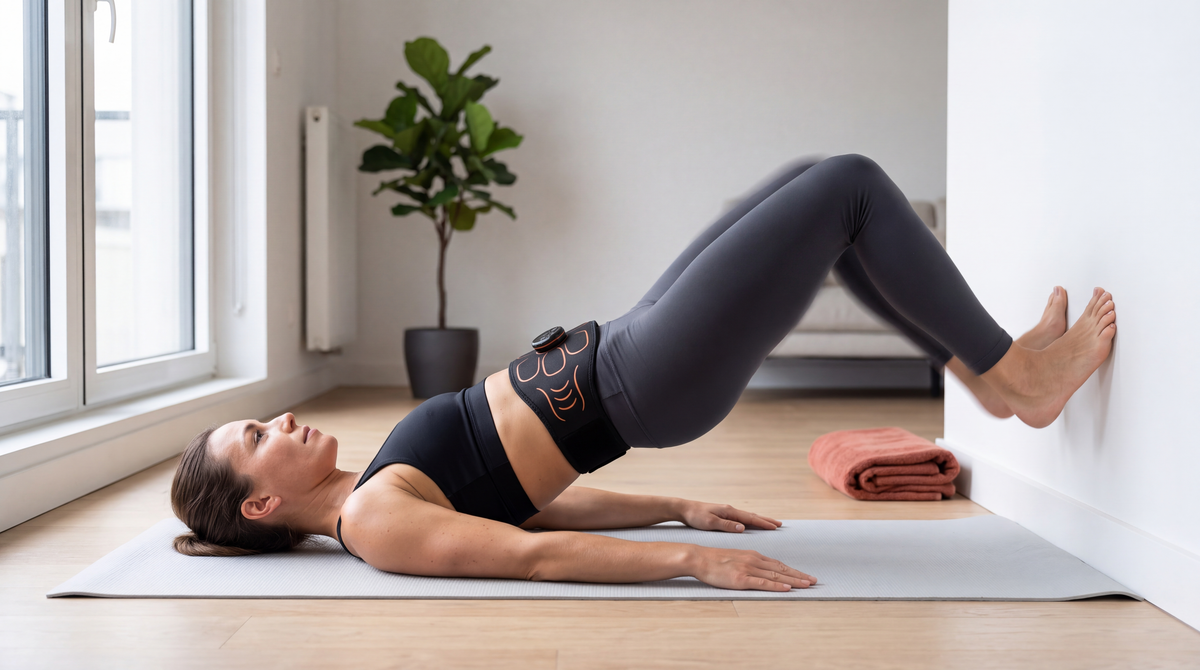
3. Glute bridge with feet on the wall
Lie on your back, feet flat on the wall, knees at 90 degrees, arms by your sides. Exhale, press your feet into the wall and lift your hips until your shoulders, hips and knees are in line. Inhale at the top, lower slowly as you exhale. Ten to twelve reps. Common mistake: lifting too high and arching; it is the glutes and hamstrings that should be working, not the lower back.
4. Marching with feet on the wall
Same starting position, hips on the floor, hands on your hips to check that they stay stable. Exhale and lift one foot off the wall, drawing your knee toward you without your pelvis moving. Put it back, switch legs. Eight reps per leg. Common mistake: the lower back arching as soon as the foot leaves the wall, a sign that the transverse abdominis has let go.
5. The Hundred with legs on the wall
On your back, legs resting against the wall, arms straight a few centimeters above the floor. Lift your head and shoulders, looking toward your thighs, then pump your arms up and down: inhale for five pumps, exhale for five. Start with fifty pumps and aim for one hundred in week 4. Common mistake: pulling on your neck; if it gets tired, rest your head and keep pumping.
6. Wall plank
Facing the wall, hands flat at shoulder height, walk your feet back until your body forms a slanted line from heels to head. Navel toward your spine, shoulder blades apart. Twenty to forty-five seconds. To progress, move your feet ten centimeters further back each week. Common mistake: hips rising or sagging.
7. Wall push-ups
From the wall plank, inhale as you bend your elbows to bring your chest toward the wall, elbows pointing down and back, then exhale as you push away. Ten to twelve reps. Common mistake: flaring the elbows out horizontally, which loads the shoulders instead of the chest and arms.
8. Side leg raise, hand on the wall
Stand side-on, one hand on the wall, standing tall. Exhale and lift your outside leg to the side, foot pointing forward, without tilting your torso; lower it without touching the foot down. Ten reps per side. Common mistake: leaning toward the wall to lift higher, which shifts the work from the hips to the waist.
The 4-week wall Pilates program, week by week
The framework: three sessions a week (Monday, Wednesday and Friday, for example), never two days in a row during the first two weeks, each with a three-minute warm-up beforehand and two minutes of wall stretches afterwards. The times and reps below are our guidelines for a healthy beginner, not a protocol taken from a study: adjust them to how you feel.
Week 1: learn the positions (15 minutes)
Six of the eight exercises (roll-down, wall sit, bridge, marching, plank, side leg raise), one set only, at the lower end of the range: wall sit 20 seconds, bridge 10 reps, marching 6 per leg, plank 20 seconds, leg raise 8 per side. Thirty seconds between exercises to reread the instructions and check your position. The goal is not fatigue, but precision.
Week 2: build consistency (20 minutes)
All eight exercises, two sets each, adding the Hundred (50 pumps) and push-ups (8). Rest reduced to twenty seconds. This is often the week you notice the first changes: deeper breathing, a less stiff lower back in the morning, better awareness of your pelvis.
Week 3: raise the intensity (22 minutes)
Still two sets, but the tempo slows down: three seconds up, three seconds down on the bridge and push-ups. Wall sit 30 to 35 seconds, plank 35 seconds with feet ten centimeters further back, Hundred at 70 or 80 pumps, marching 10 per leg. Too easy? Lengthen the holds. Sore for more than 48 hours? Go back to the week 2 values.
Week 4: consolidate and test (25 minutes)
All eight exercises as a circuit, two rounds, fifteen seconds of rest between exercises and two minutes between rounds. In the third session, take stock: wall sit 45 seconds, bridge 15 controlled reps, plank 45 seconds, full Hundred. Three markers matter more than the scale: a plank without shaking, marching without your pelvis tipping, and a smoother roll-down than in week 1.
How long before you see results with a wall Pilates program?
The first two weeks bring results you can feel: deeper breathing, longer holds, deep abdominal muscles that engage automatically when you carry something heavy. In week 4, the end-of-program test puts numbers on your gains in muscular endurance, consistent with what studies measure. Visible changes to your figure depend far more on your diet, sleep and overall activity than on twenty minutes of wall Pilates three times a week. Professionals asked about 28-day challenges agree: it is consistency over several months, at two or three sessions a week, that produces lasting effects. That is also the limitation of viral challenges that repeat four identical weeks: without progression, the body plateaus. This program increases the load every week, and you can follow it with our 30-day home Pilates program.
Limitations, mistakes to avoid and contraindications
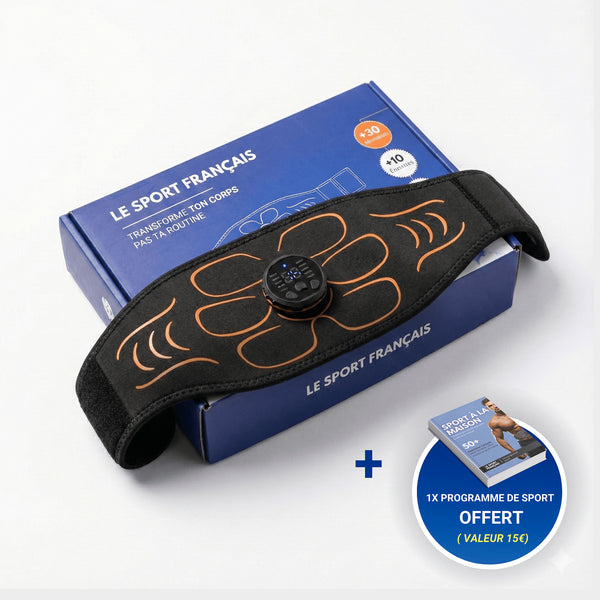
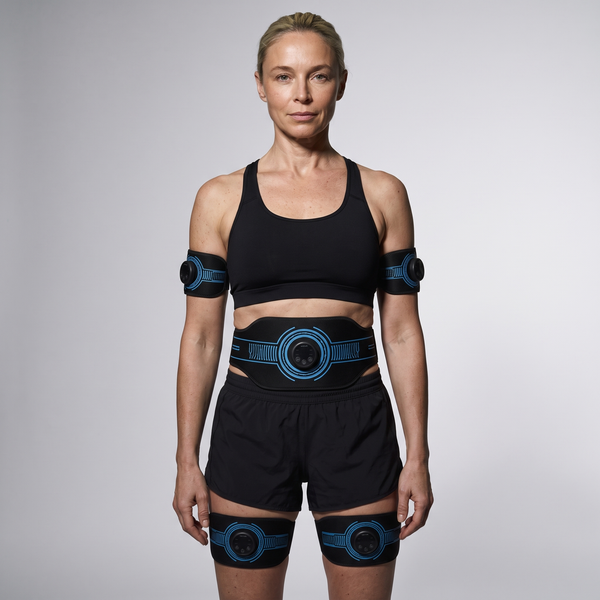
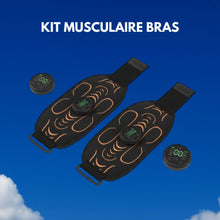
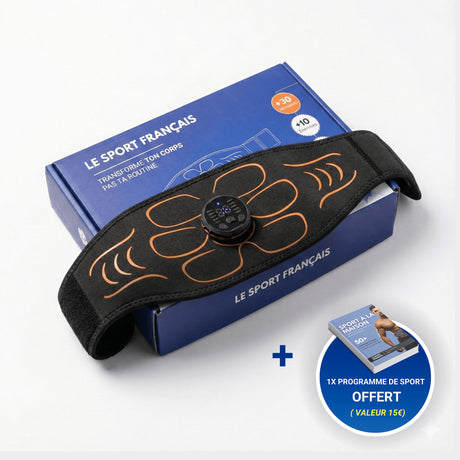
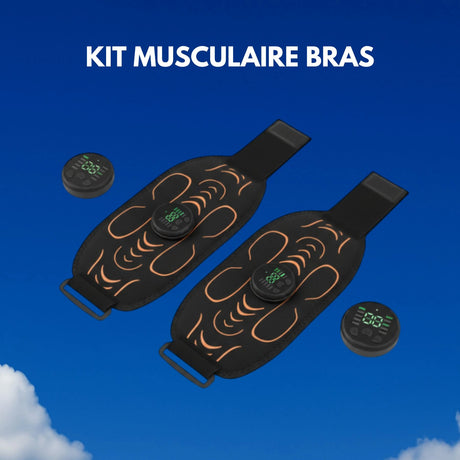
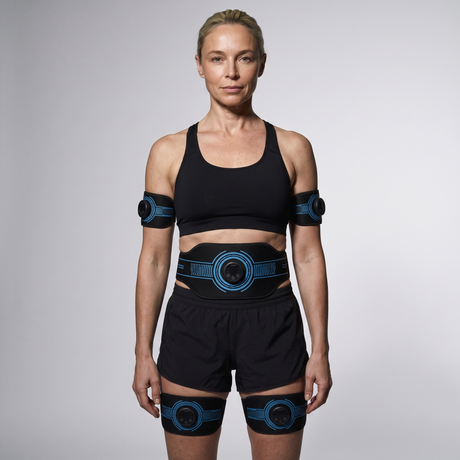
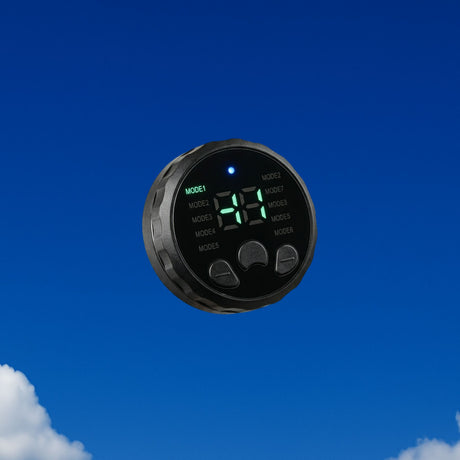
Wall Pilates is neither a cardiovascular workout nor a muscle-building program: the resistance from the wall and your body weight quickly tops out, and after four to six weeks you will need to add load (resistance bands, small dumbbells, a small ball squeezed between your knees) or move on to mat Pilates. The wall can also mask poor technique: it is easy to “cheat” by pushing with your lower back on the bridge or leaning your full weight into the plank. Finally, electrical muscle stimulation can complement the voluntary work of the deep abdominal muscles but never replaces it; if you use an EMS ab belt, think of it as an extra between two sessions, not a shortcut.
The most common mistakes: holding your breath, arching your lower back during the bridge and marching, letting your knees go past your toes in the wall sit, rushing to “finish” the set, and training every day from the very first week. If you have ongoing lower back pain, start instead with our article on Pilates for back pain.
Frequently asked questions
Can you do wall Pilates every day?
A gentle daily practice (mobility, breathing, roll-downs) is not a problem. The strength sessions in this program, on the other hand, are best spaced at least one day apart during the first month; three sessions a week are enough to make progress.
Does wall Pilates help you lose belly fat?
It strengthens the deep abdominal muscles and improves posture, which is why many people feel their stomach looks flatter. On its own, it does not melt belly fat: the energy burned in one session is low, and spot reduction does not exist. A balanced diet and regular cardio remain essential.
Wall Pilates or mat Pilates: which is better for beginners?
The wall is the safest option for learning alignment and breathing without an instructor. Once you have mastered the eight exercises, mat Pilates broadens your repertoire and challenges your balance more; the two complement each other in the same week.
Is wall Pilates suitable after 50?
Yes: the 2021 meta-analysis cited above, conducted in people over 55, shows moderate benefits for strength, balance and flexibility, and the support of the wall makes standing exercises safer. If you have osteoporosis or a joint replacement, ask your doctor about spinal flexion.
Conclusion: the wall as a starting point, not a destination
This 4-week wall Pilates program does not promise a guaranteed flat stomach or a transformation in 28 days. It promises something more useful: learning eight fundamental movements with clean technique, setting up three manageable weekly sessions and measuring concrete progress after one month. The wall is a patient teacher; when you no longer need it, you will know you have made progress.
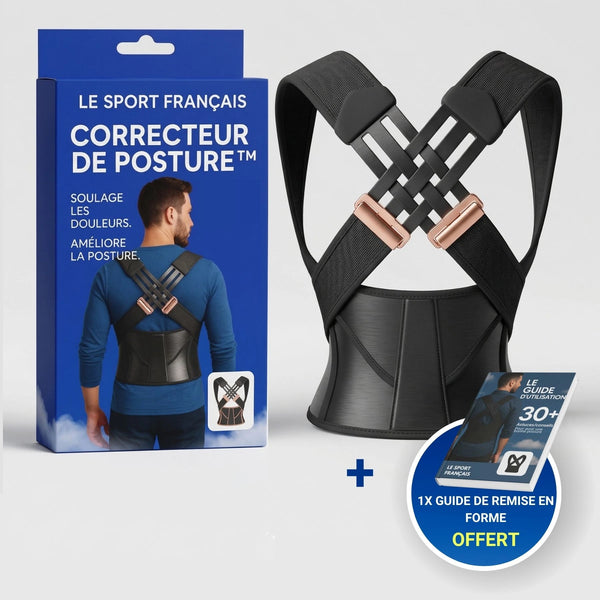
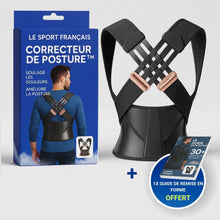
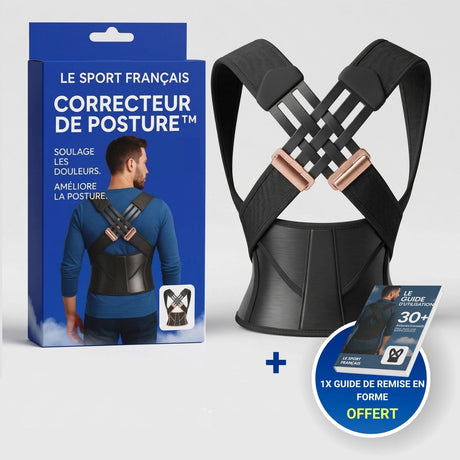
Between sessions, a posture corrector worn for short periods can serve as a physical reminder at your desk, without replacing the active strengthening you are building here. To go further, read our complete guide to Pilates at home and our 10 core exercises to do at home.
Sources: ANSES, “Manque d’activité physique et excès de sédentarité : une priorité de santé publique” (Lack of physical activity and excessive sedentary behavior: a public health priority); Meikis L., Wicker P., Donath L., Frontiers in Neurology, 2021 (meta-analysis, 51 studies); “Effect of the Pilates method on physical conditioning of healthy subjects: a systematic review and meta-analysis” (9 randomized trials); Li F. et al., BMC Sports Science, Medicine and Rehabilitation, 2024 (systematic review, posture). The program’s times and reps are editorial guidelines and are not taken from these studies.